Biochar is having a moment.
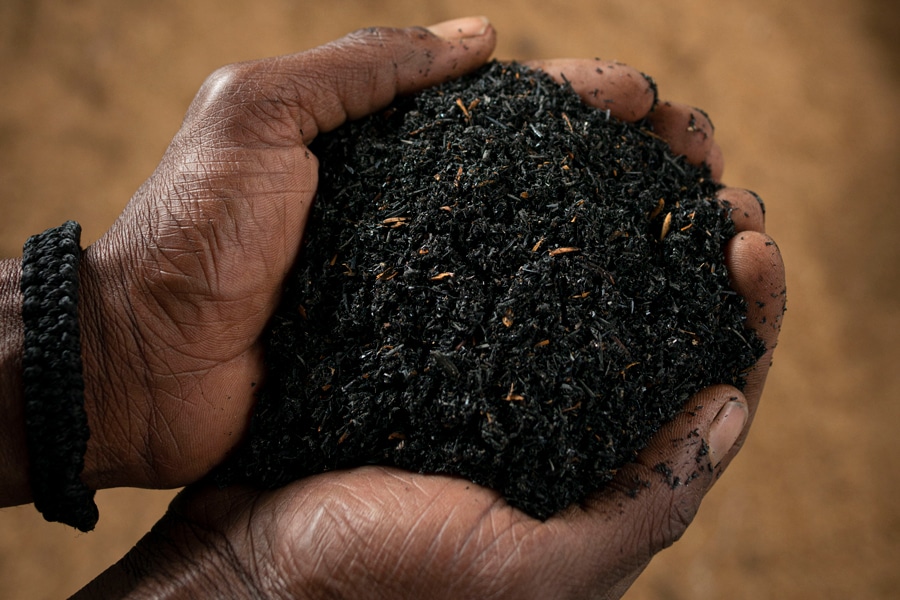
Through pyrolysis, agricultural waste and other biomass can be turned into stable carbon and stored in soil or other sinks, removing carbon from the atmosphere. And as a fertilizer, biochar restores soil health, increasing farmers’ yields and incomes and reducing the use of synthetic and often imported fertilizers.
Those carbon removal capabilities give biochar a competitive advantage over other fertilizers. High-quality carbon removal credits from biochar are fetching $120 per ton or more. The additional revenue can be used to reduce fertilizer prices to farmers and improve returns to biochar producers, creating a virtuous circle.
That’s how Africa Climate Ventures, a venture-building studio and early-stage investor, sized up the market opportunity. The investment firm considered launching its own biochar venture in-house after evaluating 30 biochar companies already in the market.
The high cost of competing fertilizer is making Africa, with its abundant biomass and millions of small farmers, a hotbed of biochar activity. Globally, biochar revenues have been nearly doubling year over year, according to the International Biochar Initiative, which tallied $600 million in global biochar revenues 2023 and estimated the market would reach $3 billion this year.
Then Africa Climate Ventures identified Safi Organics, which had been started a decade earlier by Joyce Kamande and Samuel Rigu in their final year of university. They had launched Safi in Mwea, one of Kenya’s largest rice growing regions, which had an ample supply of rice husks, a byproduct of milling with no commercial value. Safi converts agricultural waste into biochar-based fertilizers, which it claims improve crop yields by nearly one-third, outperforming synthetic fertilizers in its controlled trials.
Safi’s operations provided an additional co-benefit: The creation of jobs for local youths, whom Safi recruited to operate the company’s pyrolysis kilns to create the biochar. A team of 15 youth running three shifts per day can produce about a ton of biochar per day, creating a subsidy of about $100 per day.
“We ended up investing in them because we wanted to be a fertilizer-first company, because we saw biochar as a neat way to turn carbon into a subsidy for making these products,” Africa Climate Ventures’ CJ Fonzi told ImpactAlpha.
“When we invested, we knew we wanted to begin to produce carbon credits. We were hoping we could find a way to use these artisanal kilns for credit,” Fonzi said.
High-quality credits
Carbon removal is rapidly moving up the agenda of climate investors, as it becomes clear that renewable energy and decarbonization can’t scale up fast enough to put a dent in the growing carbon load in Earth’s atmosphere. Direct air capture technologies remain expensive – with prices of up to $600 per ton – making biochar and other nature-based solution the low-cost alternative for high-quality carbon removal credits.
The Houston-based startup Mati this spring won $50 million in the XPRIZE Carbon Removal competition, for its “enhanced rock weathering” process that also sequesters carbon in soil and improves soil health. Finalists like Applied Carbon, Mash Makes and Takachar used biochar to compete for the X-Prize.
The carbon removal market grew 78% last year, according to London-based Supercritical, which offers a marketplace for carbon removal credits. In its latest biochar offtake report, Supercritical found that biochar is preferred by 80% of carbon removal buyers, due to its scalability and cost-effectiveness. Much of the available supply is already locked up in offtake agreements with companies like Microsoft and Volkswagen, pointing to the need for additional suppliers.
In Nigeria, Releaf Earth launched the country’s first industrial biochar plant in May. The company uses palm kernel shells, a byproduct from palm nut processing as the primary raw material for biochar production.
Similar to Safi, the company is generating carbon credits and just secured its first carbon removal client via the Milkywire Climate Transformation Fund, which is backed by the Swedish bank Klarna, Salesforce and Spotify.
Upgrade financing
To Africa Climate Ventures, the carbon-removal credits were attractive as a way to subsidize an agricultural commodity while spurring local job creation. But the primary draw was Safi Organics’ ability to produce fertilizer for Kenya’s local market at a price well below that of synthetic fertilizers imported from Europe. That gave Safi an early revenue stream that enabled it to scale production as global carbon markets develop.
Safi had reached profitability over seven years, growing nearly 50% to 100% year-on-year, Fonzi said. Africa Climate Ventures acquired a 30% stake in Safi with a $750,000 investment last year. The firm helped Safi finance a 6,000-ton factory and helped get its carbon credits certified and registered through Finland-based Puro.earth, which certifies biochar removal measurements. Fonzi said ACV is planning to put in an additional $350,000 into Safi, for the production of granulated fertilizers.
Safi claims it has been able to sequester around 1.7 tons of carbon dioxide from the atmosphere per acre in a year.
These revenues are to subsidize fertilizer to the tune of $6 per bag, meaning Safi can sell at $20 for a 50 kilogram bag. On average, synthetic fertilizers cost around $27 or more in Kenya, for the same quantity.
The revenues also support Safi’s local employment strategy, which involves financing Puro.Earth-certified pyrolysis units which are used in converting the agricultural waste into biochar.
The youth empowerment factor was embedded in Safi’s original goals. Instead of producing all its biochar in-house, Safi works with local youth groups which employ around 10 to15 people. They collect agricultural waste and produce biochar using basic artisanal kilns. Safi buys the biochar from them.
The youth groups also act as a word-of-mouth advertisers when they source for the raw materials from farmers. Safi is working on partnerships with smallholder farmer co-operatives, banks and farmer financier One Acre Fund, to distribute its fertilizers within their networks.
Safi had originally trained and worked with these groups before ACV’s investment, to outsource production and meet the growing demand for its fertilizers.
The company plans to continue working with the youth groups and to provide a pathway for them to own the equipment itself. Safi plans to use carbon credits generated in the future to finance new equipment and transition these groups from artisanal kilns to pyrolysis units, which are more efficient and produce around one ton of biochar a day. The revenues from carbon credits will be used to guarantee loans to acquire these units. Safi provided one of the $40,000 pyrolysis units to one of the 10 youth groups it’s working with.
“For us, it’s really valuable because it reduces the overall cost of the biochar, which then allows us to reduce the cost of a fertilizer,” Fonzi said. “If we can use some of the revenues to secure a loan against the pyrolysis machines, that’s creating assets for the youth groups.”