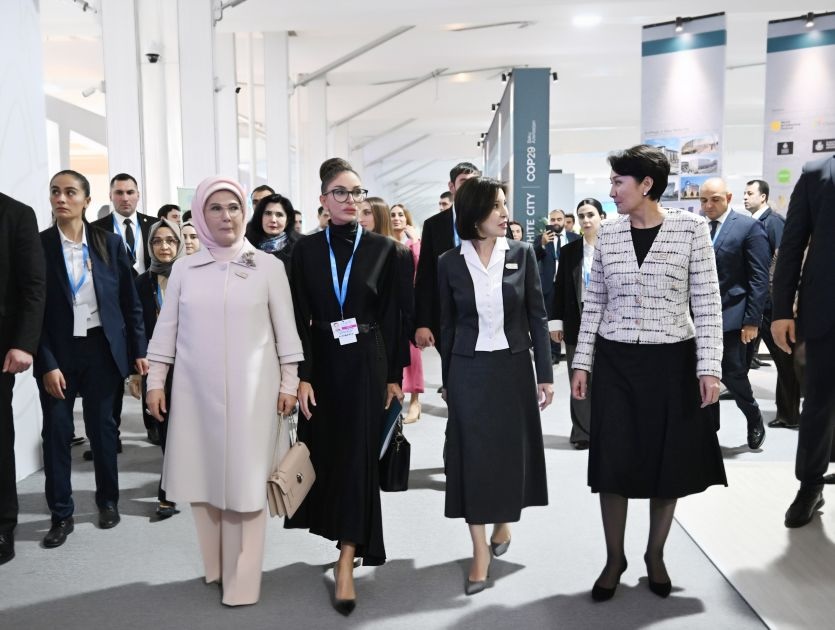
The group photo of global leaders assembled at the COP29 climate summit in Baku, Azerbaijan – the ones who dared to show up – showed the usual old boys club. But a persistent crew of women are putting themselves in the center of high-stakes climate conversations.
A social media campaign launched this week by Catherine McKenna, Canada’s former environment minister, and María Mendiluce of the We Mean Business Coalition, is lifting the work of female climate leaders, along with climate morale. Razan Al Mubarak, the UN Climate Change High-Level Champion for last year’s COP summit in Dubai, is pushing the issues of gender, nature and biodiversity. Hindou Ibrahim, the Indigenous climate activist from Chad, is championing the knowledge of Indigenous communities and the shift to a nature-based economy.
“We’re really seeing women’s leadership show up by getting to the heart of what needs to be solved for and coming up with right-sized, fit for purpose, proximate solutions,” says Sana Kapadia of Heading for Change, the climate + gender investment initiative launched by the late Suzanne Biegel. Kapadia joined ImpactAlpha’s David Bank on the latest Agents of Impact podcast from Dubai before heading to Baku.
“It’s more of a systems-level approach to leadership and to investing that we’re seeing take shape,” she says.
The “Finance COP” is focusing on a new target for financing climate mitigation and adaptation in vulnerable and low-income countries, and strengthening global carbon markets. Discussion of how climate change affects women and how women drive climate action is largely absent from the official COP29 agenda. The new carbon market standards approved this week, for example, have been criticized for lack of attention to human and community rights.
Kapadia is hoping “to advance dialog on why and how gender-responsive climate finance matters.” Less than 1% of the $1.5 trillion in committed climate capital last year included a gender lens. But women’s livelihoods are more closely tied to land and natural ecosystems needed to sequester carbon and ensure that carbon credit projects succeed. Also, companies that have at least 30% female board representation have stronger climate governance and innovation and manage emissions better than those with fewer women on their boards.
Heading for Change is seeing the impacts and opportunities across its own investment portfolio, whose fund managers apply a gender lens to a host of different climate issues (the circular economy, renewable energy, the build environment, regenerative agriculture) and financial instruments.
“It’s more of a systems-level approach to leadership [and] also to investing that we’re seeing take shape,” Kapadia says. “Gender and climate are increasingly seen as a way to enhance social and environmental outcomes.”
In Baku, Kapadia’s focus will be on how “the differentiated needs of women and under-represented Indigenous communities” are being considered in the design of climate finance products and solutions.
“Ultimately, it has to be a more participatory approach—that helps us make better decisions,” says Kapadia. “That’s why diversity matters, right?”