

TGIF, Agents of Impact!
- Roundup: Prudence
- Podcasts: Hear from Tirtha Patel, John Morris and Susana Garcia-Robles
- Chart: Oil shock, energy transition
- Spotlight: European climate tech
🗣 Prudence. If you’re an AI company looking for red lines not to cross, you might consider robot killing machines and global surveillance. After Anthropic’s showdown with the Pentagon, President Trump told Politico that the company is “in trouble because I fired [them] like dogs, because they shouldn’t have done that.” We’ll see. Anthropic’s Claude chatbot soared to the top of the app-store leaderboards, and so far corporate customers have stood by the company. The episode also elevated the profile of investors in “responsible AI,” who argue that safety, guardrails and accountability make the technology more, not less, valuable, as I wrote this week. The $5 million stake in Anthropic taken in 2024 by Omidyar Network, along with the Ford and Nathan Cummings foundations, is worth many times that now. Omidyar’s Mike Kubzansky told us, “When an AI company draws a line against autonomous weapons and mass surveillance — and holds it under enormous government pressure — that’s our investment thesis in action.”
The duty of care — to avoid careless acts that could foreseeably harm others — is an important part of fiduciary responsibility. In batting down the objections of many philanthropists to impact investing, Woodcock Foundation’s Stacey Faella cites IRS guidance that foundation managers may indeed consider “the relationship between a particular investment and the foundation’s charitable purposes.” For business owners, selling out to a perpetual purpose trust solidifies more affirmative obligations to employees, customers and communities, as ImpactAlpha’s Dennis Price reported from the first gathering of the Purpose Trust Ownership Network in Austin. Cutting workers in on the business value they create is such a powerful idea, Roodgally Senatus reports, that private equity buyout firms with such shared ownership plans are now confronting the question, “Why not share more?”
The affirmative duty of care was on display at the FLII in Mérida, where impact dealmakers took on the gathering’s challenge to move more money, more effectively, as Erik Stein reported from the scene. Contributing editor Marilyn Waite offered a host of ways that climate investors can build a diversified portfolio in Mexico. Investors and entrepreneurs are building AI for good in Europe, as Danielle Rossingh documents in her profile of Norrsken VC; and in India, as Shefali Anand reported from Delhi, where last month’s India AI Impact Summit drew more than 70,000 people. Convergence’s Andrew Apampa and Min Hung Cheng of the Global Asia Insurance Partnership urged impact investors to lean into risk analysis to bring insurers to the table in blended finance transactions.
Our duty of care extends to each other as well, Agent of Impact Todd Khozein of Second Muse reminds us in a video message that makes personal the stakes of the new war with Iran, for his family and compatriots. Amid the complex cross-currents, he urges, “Reach out, understand, express support. We don’t need to have all the geopolitical answers to begin healing our communities.” – David Bank
Next Week’s Call
Building an investment portfolio that makes aging an asset. At 1843 Capital, Tracy Chadwell is investing in “AgeTech” solutions for the workplace, health care and consumer goods. At Next50, Peter Kaldes is aligning the Denver-based foundation’s $265 million endowment around an “aging investment framework” that steps up from age-friendly to age-inclusive to age-centered. On Call No. 79, Chadwell, Kaldes and Preeti Bhattacharji, head of sustainable investing for J.P. Morgan’s US Private Bank, will join other Agents of Impact to share tips for building investment portfolios across asset classes that value and support aging, Wednesday, March 11 at 10am PT / 1pm ET. RSVP today.
The Week’s Podcasts
🎧 This Week in Impact. Host Brian Walsh takes up ImpactAlpha’s top stories with editor David Bank. Up this week: Anthropic’s standoff with the Pentagon puts impact investors’ AI thesis to the test. Plus, if private equity is sharing some wealth with employees, why not share some more? And, Woodcock Foundation’s Stacey Faella’s takedown of six common excuses foundations use for not investing for impact.
- Listen to the new episode of This Week in Impact. Get the podcast in your feed by subscribing on Apple, Spotify, or YouTube.
Agents of Impact: CaribGROW’s equity financing Caribbean food systems. Caribbean nations import roughly $6 billion in food each year. With CaribGROW, Intentional Asset Management’s Tirtha Patel and John Morris are looking for Caribbean-based food companies that reduce imports or boost exports, including through hydroponics, aquaponics and vertical farming.
👩🏫 Women Changing Finance: What it takes to invest in emerging markets. Capria Ventures’ Susana Garcia-Robles joins host Krisztina Tora to share lessons from nearly three decades of venture investing in Latin America, including the failure of early efforts to build “green funds,” the importance of strong financial returns, and what she has learned from backing 90 venture funds.
The Week’s Chart
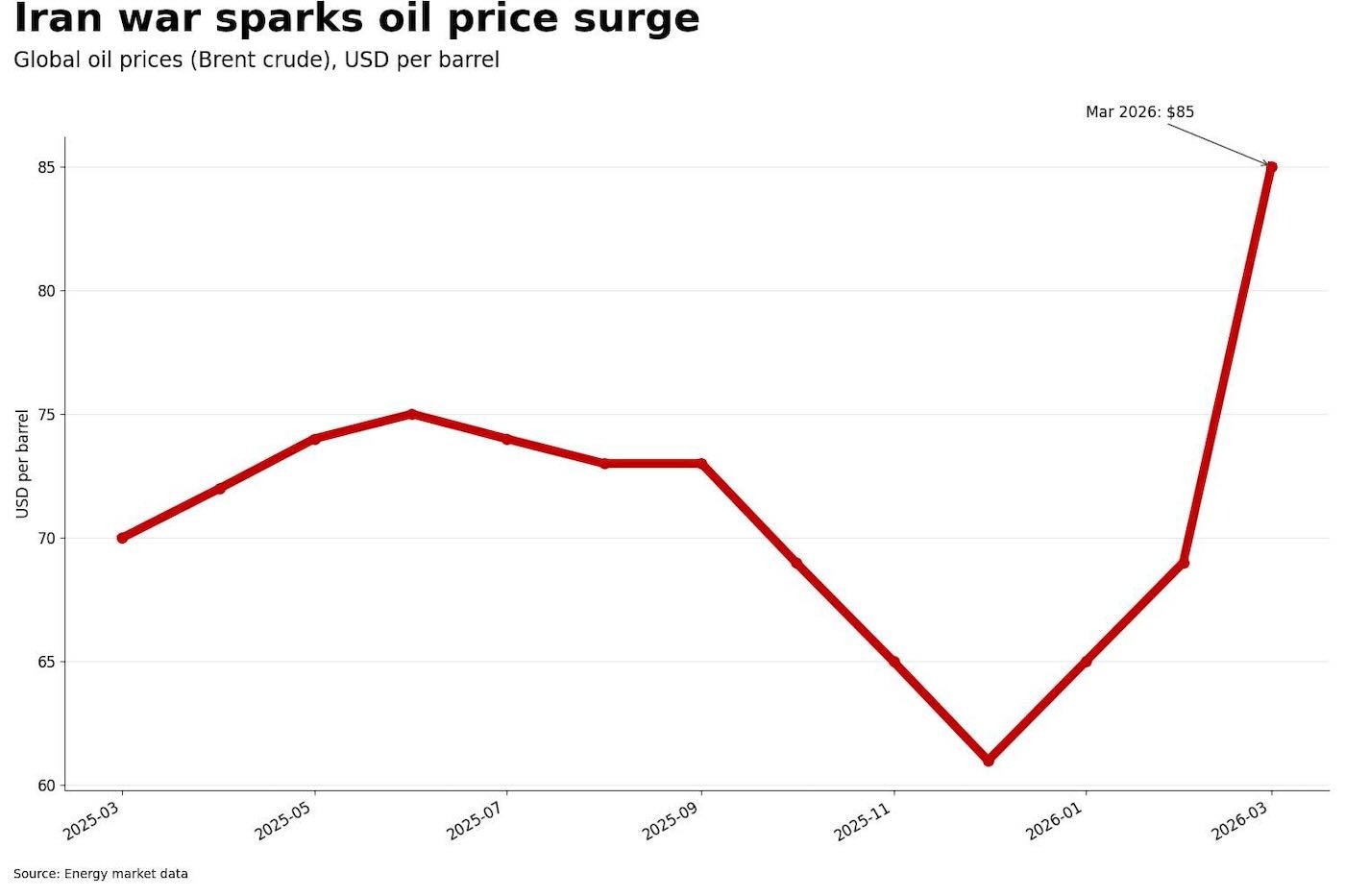
Will (yet another) oil and gas shock accelerate the transition to clean energy? The US strikes on Iran and retaliatory attacks have shut down oil and gas shipments through the Strait of Hormuz and debilitated oil refineries and liquified natural gas terminals in neighboring states. Oil and gas prices have spiked, making heating homes, filling gas tanks or running factories more costly. It’s the second such shock in less than five years — prices spiked even higher after Russia’s 2022 invasion of Ukraine. With energy sovereignty the new watchword for nations in a volatile world, a war instigated by a drill, baby, drill president, could backfire on fossil fuel producers. “For oil and gas, the Strait of Hormuz is a lose-lose,” quips Zach Stein of Carbon Collective. Low prices at the end of last year eroded profits for oil and gas producers, making all but the lowest-cost producers economically unviable. High prices that now may goose profits “lead to demand destruction,” Stein tells ImpactAlpha. Cheap solar, wind and battery storage provide both energy sovereignty and price security. Stein says there’s no way “things like this don’t hasten the energy transition.” — Amy Cortese
The Week’s Deal Spotlight
European climate investors embrace growth-stage deals. Dutch decarbonization startup RIFT this week raised €83 million in Series B financing from the Dutch pension fund PGGM and other European institutions. The scale-up deal was welcomed by Europe’s early-stage heavy funding scene as a signal of growing appetite among European investors for homegrown climate innovation ready for commercialization. The shift reflects a newly urgent desire for energy resilience and technological sovereignty as old alliances crumble and new geopolitical risks erupt (see chart, above). Climate and deeptech are “where sovereignty is going to be decided,” Yann de Vries of Kembara, a new European growth-stage fund, told ImpactAlpha. “Europe has finally realized that they are not in control of these core technologies.”
- Growth gap. Europe has more climate tech startups than ever, but not enough growth capital to help startups build their first commercial plants and score paying customers. European Series B rounds on average pull in 20% less than those in the US, according to World Fund, a Berlin-based venture capital firm founded five years ago to invest in climate scale-ups. The firm says the annual Series B shortfall of $2.7 billion means that each year more than three dozen European climate tech startups fail to raise enough to move from prototype to production.
- First of a kind. RIFT, which spun out of Eindhoven University of Technology, is pioneering iron fuel cells to decarbonize heat-intensive industries such as food and beverage, pulp and paper, and special chemicals. RIFT is focused on “preparation and execution of our first commercial project,” CEO Mark Verhagen told ImpactAlpha. PGGM teamed up with the Netherlands’ Invest-NL, Rubio Impact Ventures and regional Dutch development agencies to finance RIFT’s series A and B rounds. Verhagen locked in multi-year funding from his investors to overcome what he called a “chicken and egg” problem of securing financing from investors wary of committing to risky first-of-a-kind projects. “Most of the companies facing that moment of final investment decision actually don’t get any money,” Verhagen said.
- Keep reading, and catch up on all of this week’s dealflow reporting.
The Week’s Talent and Jobs
💼 See and share new impact jobs posted this week on ImpactAlpha’s Career Hub. Have a job listing to post? Submit it here.
The Global Private Capital Association added four members to its board of directors: Mohamed Gouled of International Finance Corp., Horizon Capital’s Lenna Koszarny, Lucy Heintz of Actis and Michael Buchanan of Temasek… Claire Mongeau, former investor at Founders Factory, joined LGBTQ+ founders-focused venture firm identity.vc as an investment manager… Preston L. James II stepped down as CEO of DivInc… Meta Enklaar stepped down as director of strategy at FMO.
Christophe Defert and Mike D’Aurizio and their six-person team at Climate Growth Partners, a unit of HSBC Asset Management, decamped to Bridges Fund Management, in what Bridges calls a “spin in.” The new Bridges Climate Transition Partners will continue to manage the Climate Growth Partners fund and portfolio; HSBC will remain a limited partner… Tellef Thorleifsson stepped down after 8 years as CEO of Norfund… Charlotte Reinnoldt joined climate consulting firm Driftwood Climate as principal.
ImpactGC welcomed Cortney Mukushi, former associate general counsel to Calvert Impact’s Climate United Fund, as a partner… The Earthshot Prize appointed Jesper Brodin, IKEA’s former CEO, as board chair… AGRI3 Fund added Ineke Keers, previously with Smallholder Agroforestry Finance, as managing director… Industrial decarbonization investor Ara Partners promoted James Chiu to partner in its energy strategy.
Giorgi Jebashvili was promoted to debt investment officer at responsAbility Investments… Kristen Clements, former chair of the planning and transportation commission of the city of San Carlos, became Housing Trust Silicon Valley’s inaugural director of policy and advocacy… Carli Roth was promoted to director at the Rockefeller Foundation… Tim Ortez retired from his role as chief financial and investment officer at the Weingart Foundation.
That’s a wrap. Have a wonderful weekend.
– March 6, 2026