
Greetings Agents of Impact!
📞 Next week’s Call: Ramping up green lending – even without that $20 billion. Join Climate United’s Beth Bafford, Justice Climate Fund’s Amir Kirkwood, NYCEEC’s Curtis Probst and other community climate investors who are shaping a new market for green lending – even as litigation continues, Wednesday, June 11 at 10am PT / 1pm ET / 6pm London. RSVP today.
In today’s Brief:
- Assessing the clean energy impact of the proposed US tax bill
- Funding the Mission Driven Bank Fund
- Altérra invests in solar + storage in Italy
- ‘Triple dividends’ from investments in climate adaptation and resilience
Featured: Fiduciary Future
The ugly details of the Big Beautiful Bill’s damage to US clean energy competitiveness. Cuts to Medicaid and other health programs in the current version of the Republican tax and budget bill now before the US Senate could lead to more than 51,000 deaths annually, according to researchers at Yale University and the University of Pennsylvania, President Trump’s alma mater. More than three million people would lose access to SNAP benefits, formerly known as food stamps. And the $2.4 trillion the bill would add to the national debt, according to the Congressional Budget Office, caused even Trump’s one-time First Buddy Elon Musk to slam it as “a disgusting abomination.”
And then there’s the damage the GOP budget, known officially as the One Big Beautiful Bill Act, would wreak on the roll out of clean energy capacity and the reshoring of key supply chains that was just gaining traction. “There is nothing beautiful about the current budget bill’s obstruction of US clean energy progress and American economic competitiveness,” Danielle Fugere and Diana Myers of As You Sow, the nonprofit shareholder advocacy organization, write in a Fiduciary Future guest post on ImpactAlpha. “Pulling the plug on these crucial investments weakens the innovation ecosystem that historically fueled America’s economic leadership, putting the US at a competitive disadvantage with geopolitical rivals like China.”
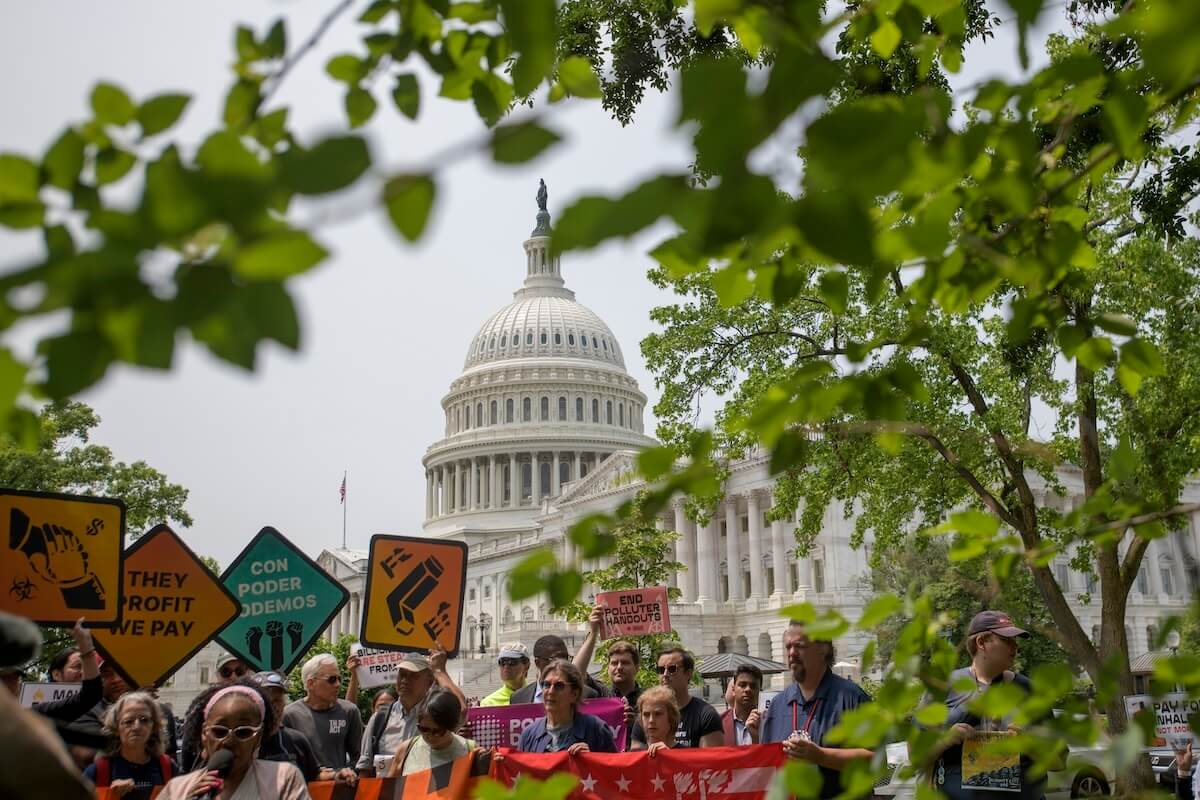
- Making the case. Should the budget bill pass the Senate in its current form, it would slash funding for critical research and development in technology and clean energy, and abruptly repeal key provisions of the Inflation Reduction Act, despite its success in driving $321 billion in new private investment across 2,369 domestic clean-energy facilities. Impact and climate fund managers descended on Capitol Hill this week to try and stem the damage. “To keep capital flowing and projects moving forward, investors need stable, predictable policy,” said Mike Reynolds of Ultra Capital, a Philadelphia-based growth equity investor. “We encourage the Senate to continue its support of the energy tax credits, which will help to unlock more private investment and fuel America’s energy dominance.” Reynolds was part of a delegation from Impact Capital Managers that met with members of the Senate Finance Committee this week.
- Second thoughts. Rep. Marjorie Taylor Greene of Georgia said she would have voted against the bill in the House over the section that would strip states’ ability to regulate artificial intelligence for at least a decade – she said she hadn’t read the full bill. Musk, who once supported cuts to clean energy investments and EV credits, has also changed his tune. Tesla has reportedly spent some $240,000 on lobbying to keep the EV credits, among other issues. Tesla faces an even bigger threat, if California is forced to end its zero-emission vehicle mandate. Tesla has padded its bottom line by $11 billion over the past decade by selling compliance credits to other auto makers that don’t meet the state’s emission regulations and federal fuel standards. The Senate has voted to end California’s waiver of federal regulations it needs for the emissions regulations. JPMorgan analyst Ryan Brinkman estimated in January that Tesla would lose $1.2 billion a year from the repeal of the EV tax credits and another $2 billion in profits from proposed changes to California’s credit program. In this year’s first quarter, Tesla would have reported a loss without the $442 million in revenues from regulatory credits.
- Read, “The ugly details of the Big Beautiful Bill’s damage to US clean energy competitiveness,” by As You Sow’s Danielle Fugere and Diana Myers.
Dealflow: Inclusive Lending
How the Mission Driven Bank Fund is tackling wealth inequalities in US communities. Microsoft and Truist answered a call from the US government’s Federal Deposit Insurance Corporation four years ago to create a pooled investment fund to finance mission-driven banks in underbanked US communities. The corporations helped launch the Mission Driven Bank Fund with an initial $120 million, which also included an anchor commitment from Warner Brothers Discovery. The private investment fund sought to raise $500 million to offer flexible, below-market-rate capital and technical assistance to FDIC-insured, mission-driven banks as well as federally designated minority depository institutions and community development financial institutions. It has raised just over $70 million in additional funds. The Mission Driven Bank Fund (unaffiliated with Mission Driven Finance) has secured commitments from banks including Enterprise Bank and Trust, Hancock Whitney Bank, Banner Bank and Lake City Bank.
- Community Finance. The fund has backed 10 mission-driven banks to date, including Grand Bank for Savings, or Grand.bank, a minority depository institution and federal savings bank in Hattiesburg, Mississippi. Grand.bank has a goal to improve the financial wellbeing of more than a million people in the state’s underserved communities by 2030. The community bank hopes to do so through “affordable homeownership” products like down-payment assistant loans and seller-financed mortgages for first-time home buyers. “The financial and technical services support of the Mission Driven Bank Fund will help us reach that goal,” said Grand.bank’s Chris Sawyer. Mission Driven Bank declined to disclose the investment amount. Other banks in Mission Driven Bank’s portfolio include American Bank, an MDI in Texas, and FNBC Bank, a CDFI that operates in Arkansas and Missouri’s underserved communities.
- Bridging wealth gaps. Mission Driven Bank, co-managed by Black-led asset management firm Elizabeth Park Capital Management and impact investor Calvert Impact, has a pipeline of 300 mission-driven MDI and CDFI banks the managers believe could make a dent in the racial wealth gap by expanding the financial capacity of local banks to finance homeowners and small businesses. Misperception of risk and other racial biases in lending from national lenders have also played a key role. Just 142 of the approximately 4,500 banks and savings institutions the FDIC insures qualify as minority depository institutions with 51% or more of the voting stock owned by minority individuals.
- Gift this post.
Altérra commits $56.3 million alongside I Squared Capital for Italian solar and battery storage projects. The UAE’s $30 billion private climate investment fund Altérra, via its Altérra Acceleration Fund, committed €50 million ($56.3 million) to Absolute Energy, an Italian developer of small to medium-scale solar projects. American infrastructure-focused private equity firm I Squared Capital, which acquired a 95% stake in Absolute Energy in 2023, was a co-investor in the deal. The funding will support the development of 1.4 megawatts of solar and battery storage projects, as part of a larger 6 megawatt pipeline. I Squared Capital’s Sadek Wahba said the two investors shared a “commitment to deploying capital with urgency and impact.”
- Capital mobilization. Altérra invests in large-scale projects via its $25 billion acceleration fund and provides risk mitigation capital for emerging markets via its $5 billion transformation fund. It has committed $6.5 billion since its launch at COP28 in 2023, either directly or via various climate transition funds managed by TPG, Brookfield and BlackRock. Its investments span wind, solar, battery storage and waste management projects in India, South Korea, Sri Lanka, France, Australia, the UK and other countries. Altérra also partnered with the Global Energy Alliance for People And Planet or GEAPP and the Rockefeller Foundation last year, to mobilize public, private and philanthropic capital for clean energy transition projects in emerging markets.
- Gift this post.
Dealflow overflow. Investment news crossing our desks:
- Australia’s Amber Electric raised A$45 million ($29 million) from ETF Partners, Rubio Impact Ventures, Breakthrough Victoria and other investors for its smart tech software that helps homeowners manage their energy usage. (Amber)
- Jua, a Swiss climate tech startup developing an AI-powered earth simulator for climate and weather forecasting, clinched $11 million of Series A funding co-led by Ananda Impact Ventures and Future Energy Ventures. (Jua)
- Climate Fund Managers invested $3 million in Ivory Coast’s Société Des Energies Nouvelles, or SODEN, to develop the world’s first grid-connected cocoa waste-to-energy power plant in Divo, a major cocoa-producing region in the country. (Climate Fund Managers)
- TPG Rise Climate is acquiring the UK’s Aurora Energy Research, which offers data-driven market intelligence to global energy transition investors and portfolio managers. (Aurora)
Signals: Impact Management
‘Triple dividends’ of climate resilience investments are highest in health and disaster management. Each dollar invested in climate adaptation and resilience yielded more than $10 dollars in benefits over the course of a decade, according to the World Resources Institute. The nonprofit calculated the returns from 320 such investments across a dozen countries totaling $133 billion, and found potential returns of $1.4 trillion, for an average annual return of 27%. The highest returns came from health projects, which had an annual rate of return of 78.5%. The high returns from health projects “is not surprising since the value of avoided losses, measured in terms of mortality and morbidity is very high,” write the authors of the report, “A Triple Dividend Approach.” The triple dividend refers to risk reduction from losses avoided due to climate disasters, economic growth from job creation, improved yields and overall social and environmental health that encompasses health and biodiversity improvement.
- Resilient infrastructure. The Kenya Water, Sanitation and Hygiene Program, for example, was launched with a total project cost of $458 million to provide climate-resilient water and sanitation services. WRI estimated the project to have a net present value of $2.57 billion. In Bangladesh, the $129 million Weather and Climate Services Regional Project, funded by the World Bank, had a net present value of $414 million. The project aims to strengthen the ability to deliver reliable weather, water, and climate information in the flood-prone country. In South Africa, the C40 Cities Finance Facility supported Transformative Riverine Management in the eThekwini Municipal Area. The nature-based solution aims to tackle flooding in the region, alongside creating jobs and improving transportation. WRI places its net present value at $2 billion, nearly six times its original cost.
- Keep reading, “‘Triple dividends’ of climate resilience investments are highest in health and disaster management” by Lucy Ngige.
Agents of Impact: Follow the Talent
Caprock taps Vivek Jindal, previously with KORE Private Wealth, as chief investment officer… Conduit Impact welcomes Emma Lupton, former responsible investment VP at Columbia Threadneedle Investments, as a venture partner… National Cooperative Bank adds Gerardo Espinoza of the Local Enterprise Assistance Fund and Sparkfund’s Bill Bush as board directors.
ImpactAlpha is hiring multiple enterprise account executives… World Wildlife Fund is looking for a senior program officer for corporate climate engagement in Washington, DC… Rewrite Capital Advisors seeks a Canada-based business development manager… Common Counsel Foundation has an opening for a deputy director for its Community Ownership for Community Power Fund… Kindred Futures is recruiting a research analyst.
ClimateWorks Foundation is hiring a senior coordinator for food and ag and funder collaborations… IFU, the Danish government’s development finance institution, rebrands as Impact Fund Denmark… Publish What You Fund, in partnership with ODI Global’s center for private finance in development, will launch the second DFI transparency index on Thursday, June 26 (for context, see, “To catalyze climate capital, development finance institutions are pressed to ‘publish what you fund’”).
👉 View (or post) impact investing jobs on ImpactAlpha’s Career Hub.
- Add team members to your subscription. Save with substantial group discounts. Start here.
- Lead the conversation. Sponsor a beat, newsletters or calls with ImpactAlpha. Get in touch.