Greetings Agents of Impact!
👋 Zoom into today’s Call: Preserving home ownership and affordability. Ownership models that walk the fine line between preserving affordability and creating wealth for low-income families are emerging across the country. Today’s Agents of Impact Call will explore shared equity, community ownership and mobile home co-ops, along with the urgent need to preserve affordability as restrictions expire on hundreds of thousands of units of rental housing, with Common Counsel’s Jazmin Segura, Grounded Solutions Network’s Devin Culbertson, ROC USA’s Paul Bradley and Impact Community Capital’s Michael Lohmeier. Now joining: Ruth Gao of Robert Wood Johnson Foundation, who is putting homeownership preservation on the agenda of funders and investors. Join hundreds of other Agents of Impact for the conversation, today at 10am PT / 1pm ET / 6pm London. There’s still time to register.
- Catch up quickly: “Unlocking and preserving broad-based ownership to make housing more affordable.”
In today’s Brief:
- Restoring faith in carbon markets
- Sustainable chocolate
- Bridge round for biodigesters
- Post-Helene, is anywhere safe?
Featured: Climate Finance
How and why to restore trust in voluntary carbon markets. It has become fashionable to dismiss carbon offsets, and the voluntary carbon markets on which they trade, as little more than venues for corporations looking to “greenwash” their greenhouse gas emissions. After concerns were raised about forest-preservation claims and community benefits, the consultancy South Pole last year ended its relationship with a major forest project in Zimbabwe that had supplied offsets to L’Oreal, Gucci, Nestlé, McKinsey and Volkswagen. While there is good reason for skepticism, “abandoning the voluntary carbon market would be a colossal setback in efforts to limit global warming to under two degrees Celsius,” argue Acumen’s Amrita Bhandari and Carbon Solutions Group’s Daniel Sadik in a guest post for ImpactAlpha. “While the system is far from perfect, no other tool matches carbon markets’ scale and momentum in reducing emissions.”
- Measurement, reporting and verification. Bhandari and Sadik argue that restoring trust and driving efficacy in carbon projects requires an overhaul in how credits are sourced, verified and monitored. Technology can help. New measurement, reporting and verification, or MRV, systems are emerging to provide “audit-ready data and ensure that every carbon credit is tied to a verifiable emissions reduction,” the authors explain. The International Emissions Trading Association has issued guidelines for improvements it says can significantly cut global emissions. “Yet, too few companies have embraced this transformative technology,” Bhandari and Sadik write, citing complexity, cost and evolving regulations. “Others resist due to the transparency MRV systems demand, which invites scrutiny of data and credit quality.”
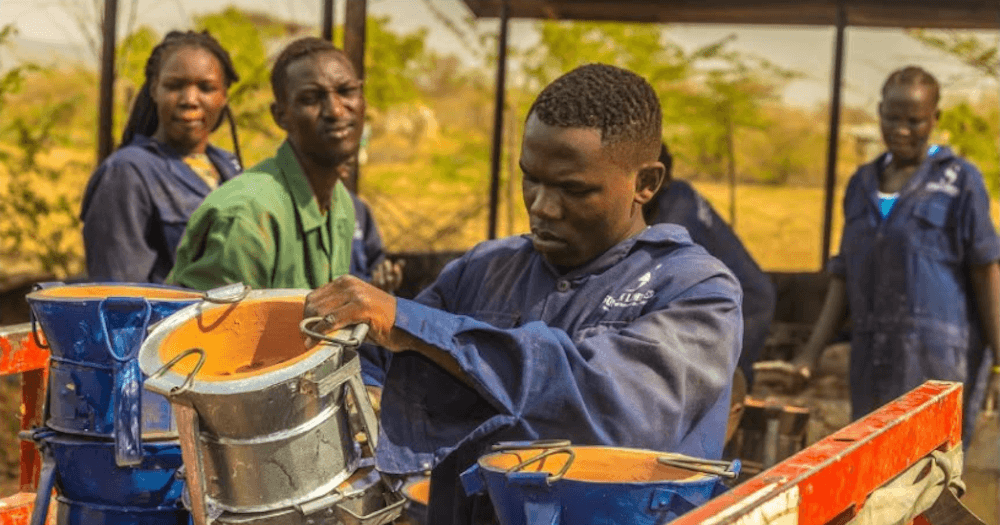
- Social co-benefits. The role of carbon offsets in sustainable development was the topic of a discussion hosted by Acumen at Climate Week NYC last month (see, “Carbon markets fall short as a climate solution, but go far in financing sustainable development”). Key to project designs: Market-based solutions that embed social and environmental benefits into business models. Kenyan clean cookstove maker Burn Manufacturing is using carbon emission avoidance data to raise capital from the voluntary markets and lower prices for customers (see, “Leveraging the carbon markets for clean cooking, climate justice and social impact“). Sistema.bio, which makes small-scale biodigesters that convert farm waste into natural gas, is testing out a carbon credits program with smallholder farmers in India (see below). Without carbon offsets, “critical funding for decarbonization efforts in rapidly growing regions would be lost, stalling the transition to green energy and harming communities that rely on these projects for energy access, health, education, and gender equity co-benefits,” write the authors.
- Keep reading, “How and why to restore trust in voluntary carbon markets,” by Amrita Bhandari and Daniel Sadik on ImpactAlpha.
Dealflow: Sustainable Agriculture
Blue Stripes raises $20 million for sustainable cocoa products. Expect fewer, and smaller, chocolate bars in your bag this Halloween. Prices for cocoa have skyrocketed amid changing weather patterns in West Africa, a major growing region (see, “How climate change is making your groceries more expensive”). Cacao farmers also face deforestation, child labor and fair trade challenges. Israeli chocolatier Oded Brenner, who previously founded global chocolate retail chain Max Brenner, launched New York-based Blue Stripes in 2018 to “to change what happens behind the scenes of the cacao industry.” For Brenner, that means reducing cacao farming’s impact on the environment and improving the economic value for farmers. Blue Stripes makes cacao-based products including flavored water, chocolate bars and dried fruits using the 70% of the fruit that is thrown away in the traditional chocolate-making process. It also better compensates small cocoa farmers.
- Economic mobility. Blue Stripes’ Series B round was led by Zintinus, a food-tech venture capital fund in Berlin, along with The Hershey Company and Whole Foods. Hershey’s investment comes from “Cocoa for Good,” the company’s 10-year, $500 million strategy to address climate and labor challenges facing cocoa farmers in West Africa, Latin America and Southeast Asia. The chocolate giant has five-year partnerships with nine cocoa-producing cooperatives in Côte d’Ivoire, the world’s largest cocoa producer, where just 13% of cacao farmers earn a living wage. “Improving farmer incomes requires a holistic approach and collaboration,” said Hershey’s Tricia Brannigan. Last year, Hershey launched a $40 million “income accelerator” program for farmers in Côte d’Ivoire.
- Check it out.
Biodigester maker Sistema.bio lands a $15 million in bridge financing. Mexico City-based Sistema.bio launched in 2010 to give smallholder farmers across Mexico a way to recycle animal waste into biofuel for cooking, heating, electrification and nutrient-rich fertilizer. ElectriFi, the EU-funded energy impact initiative for emerging economies, led the bridge round, which will provide working capital for the company ahead of an expected Series C round next year. Sistema’s modular, prefabricated biogas digesters are capable of processing between 1,000 to 10,000 gallons of waste. The company has deployed 100,000 units on small farms in 35 countries in Latin America, Africa and India, and says it has cut more than one million tons of carbon emissions per year.
- Catalytic capital. Biofuels are a promising growth market in agriculture-dependent regions. Investors in the bridge financing included KawiSafi Ventures, Chroma Impact Investment, AXA Investment Managers Alternatives, Blink CV and EcoEnterprises Fund. Triodos, FMO and EcoEnterprises extended their current lending facilities; BIX Capital and Shell Foundation provided junior catalytic capital that was co-funded with UK government aid. Chroma’s Manoël Ancion said that in supporting the startup, her firm was “investing in a future where agriculture plays a key role in the global fight against climate change and poverty.”
- Decarbonizing agriculture. Livestock operations small and large account for up to 17% of all greenhouse gas emissions, according to one calculation. Sistema.bio helps farmers document the carbon mitigation and sequestration benefits from regenerative farming with sensors and data tracking. This year it partnered with French energy company ENGIE to deploy its biogas digesters in Zambia. It also launched a program in India that seeded 400,000 tons of carbon credits. The startup aims to reach more than one million farmers globally by 2025.
Dealflow overflow. Investment news crossing our desks:
- Florida-based renewables developer BrightNight landed $260 million in tax equity financing from JP Morgan and Capital One that combines tax credits from the Inflation Reduction Act with a share of future cash flows from the developer’s Arizona solar project. (BrightNight)
- Brazil’s Asaas landed $148 million to help small businesses digitally manage their financial operations and transactions. (Latam Fintech)
- Virginia-based Molg secured $5.5 million from Closed Loop Partners, Amazon’s Climate Pledge Fund, Elemental Impact and others to build robotic “microfactories” that dismantle e-waste for reuse. (Closed Loop Partners)
- Waribei in Côte d’Ivoire landed €750,000 ($816,000) in pre-seed funding from Mstudio and Saviu Ventures to help informal traders access inventory financing. (Empower Africa)
- New York’s Ember Infrastructure, Sydney’s Virescent Ventures and Montreal’s Diagram Ventures notched funding milestones that bring the collective amount raised for their climate investment funds to more than $650 million. (CTVC)
Impact Voices: Fiduciary Future
After Hurricane Helene, is anywhere ‘climate safe’? Hurricane Helene, which rapidly intensified due to the record warm waters of the Gulf of Mexico, caused widespread destruction in Asheville, NC, a place that until recently was considered a “climate haven.” The economic toll of climate change fueled extreme weather events is estimated to cost the US an average of $97 billion a year; Helene alone is projected to cost an additional $250 billion. In his latest Fiduciary Future column, As You Sow’s Andy Behar shares the story of his colleague Kaylea Noce, who rode out the storm in Asheville, and calls for investors and individuals to invest in climate action now. “Seeds we sow today with every corporate engagement, every proxy vote, and every dollar donated to political leaders, will make a lasting impact for generations.”
- Climate inflation. Behar connects the storm damage to the broader increases in the prices of everyday goods due to human-caused climate change (see As You Sow’s microsite, climateinflation.org). Climate disasters, including Hurricane Milton as well as Helene, are prompting a shift to account for rising costs and rising risks. “Smart investors, businesses and homeowners are taking climate risk seriously,” he says. For instance, the popular real estate site Zillow now includes climate risk data from First Street. Homeowners are getting squeezed by skyrocketing rates for mandatory insurance around the country, if they can get insurance at all. “Investing in climate action taken now will cost far less than paying to repair damage in the future,” Behar writes. “We may even look back on these days as peaceful in comparison to what’s to come.”
- Keep reading, “After Hurricane Helene, is anywhere ‘climate safe’?” by Andy Behar on ImpactAlpha.
Agents of Impact: Follow the Talent
Dara Parker, previously with the Vancouver Foundation, replaces Adam Bendell as CEO of Toniic. Bendell will assume the role of president… Jason Wingard, a professor at Harvard, joins the Social Finance Institute as a senior advisor… Impact Charitable welcomes Payton Hoops, previously with Cause Strategy Partners, as client and project manager… Blue Earth Capital adds Ben Gusenburger, previously with Partners Group, as a transaction lawyer.
Roberts Enterprise Development Fund is recruiting a loan portfolio manager in San Francisco… CareQuest Innovation Partners is hiring a vice president of strategic ventures and impact investing… Neighborhood Partnership Housing Services has an opening for a director of community lending and investment… Boston Impact Initiative is looking for a director to develop a fund incubator program for emerging managers… The UN Development Programme seeks a technical director.
👉 View (or post) impact investing jobs on ImpactAlpha’s Career Hub.
Thank you for your impact!
– Oct. 16, 2024