
Greetings Agents of Impact!
In today’s Brief:
- The promise of tele-health in rural India
- Distributed solar infrastructure in the US
- Decarbonizing logistics in Latin America
- Engineering inclusion
Featured: Investing in Health
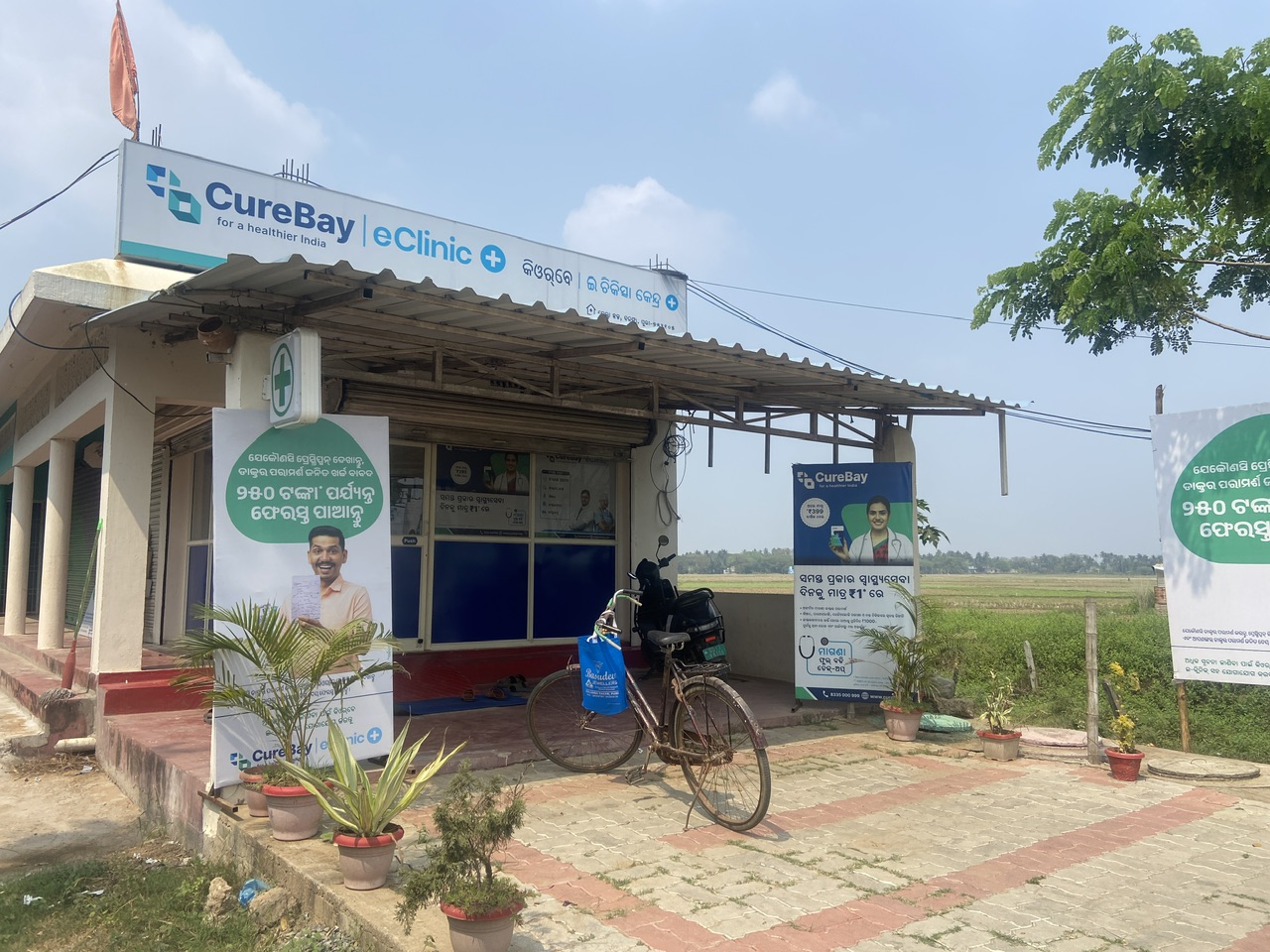
Can tele-health finally bring quality care to India’s rural patients? On a recent Thursday, Hasina bibi sat on a bench along with other patients, waiting to meet a doctor – on a screen. She had traveled about 30 minutes from her village to a virtual clinic run by health tech startup CureBay, rather than going to a clinic in another town. “This is a good facility,” she told ImpactAlpha’s Shefali Anand. CureBay aims to provide essential, accessible and quality healthcare for villagers like Hasina, who didn’t share her last name, and to prove that such virtual care can be not only cost-effective but profitable. The four-year-old company operates 150 clinics in Odisha and Chhattisgarh that each serves patients within a six-mile radius. Most clinics break even in 18 to 20 months, CureBay co-founder Priyadarshi Mohapatra tells ImpactAlpha. “People in rural India are underserved. They are not underprivileged.”
- Rural healthcare market. India’s rural households spend about $45 billion annually on healthcare, not including their travel to cities for medical needs, according to Elevar Equity, a CureBay investor. Elevar’s affiliate, EPIC World, has found that most rural households have to travel more than an hour to see a health specialist; nearly 80% would pay more to access better care locally (for background see, “Elevar Equity says low-income customers are more profitable – and has the data to prove it”). “The rural healthcare market in India presents a significant and largely untapped investment opportunity,” says Jyotsna Krishnan of Elevar and EPIC World.
- Health friends. Efforts to extend the reach of doctors and health specialists into India’s rural areas via telemedicine have had limited success. Most of India’s heavily-funded healthcare startups cater to a tech-savvy urban population. The government’s free national telemedicine service, eSanjeevani, has faced difficulties, including a shortage of doctors, poor network connectivity, and failure to address patients’ followup needs. Another barrier: rural communities are skeptical of urban providers. “They have a very tightly knit community,” says Shubhang Tandon of Online Chikitsa Mitra, another virtual health provider, which is based in Lucknow in the mostly rural state of Uttar Pradesh.
- Competing models. Online Chikitsa Mitra teaches local pharmacy owners to take patients’ vitals and schedule online consultations via its app. Its fairly limited set of services is delivered through a network of about 560 pharmacies in Uttar Pradesh. CureBay has a smaller footprint but offers more extensive services through its own clinics, which employ nurses on-site. It’s betting that it can help residents in rural India be more proactive about their health needs with memberships that let them schedule unlimited consultations and discounted tests for less than $5 per year. CureBay is again fundraising to expand into additional states, after a $7.5 million raise last year, says Mohapatra. “The opportunity is massive.”
- Keep reading, “Can tele-health finally bring quality care to India’s rural patients?,” by Shefali Anand on ImpactAlpha.
Dealflow: Energy Transition
Aligned Climate Capital raises $240 million for its sixth distributed solar fund. Clean energy investment firm Aligned Climate Capital has found a sweet spot in distributed solar infrastructure. “The US needs new power generation to meet growing electricity demand, and solar energy is the cheapest, fastest and cleanest technology on the market,” said Aligned Climate’s Peter Davidson. The New York-based fund manager, with $2 billion in assets under management, raised $240 million for its sixth and largest solar infrastructure fund. The fund will acquire ready-to-build solar projects from US development partners in underserved and rural markets and finance the buildouts with a mix of equity and construction debt.
- Income producing. Aligned Climate plans to package the solar assets into large portfolios to be sold to institutional infrastructure investors. During its management, Aligned Climate will use tax credits to generate cash for investors. The future of some of those credits are up in the air as Republicans in Congress hash out a budget and tax bill. Aligned’s sixth solar fund has already acquired over 25-megawatts of distributed solar projects and will make its first distributions to investors later this year. “We have been investors in this market for more than a decade and understand how solar can deliver consistent cash returns for our investors each year,” Davidson said.
- Institutional impact. The fund raise, Aligned Climate’s second this year, drew allocations from insurance companies, endowments, foundations and family offices in the US and internationally. In March, Aligned Climate closed its second clean energy venture fund, backed with $85 million from the Rockefeller and Ford foundations and other institutional investors. The venture fund targets companies in electric mobility, green infrastructure, sustainable land use and renewable energy generation.
- Gift this post.
Royal America offers a $26 million green bond with backing from responsAbility and IDB Invest. Royal America sells and leases electricity-powered equipment for logistics and cargo in Chile, Ecuador and Colombia. The company issued a $26 million, seven-year bond with support from Swiss impact investor responsAbility and IDB Invest. The bond is structured in two tranches. The first, up to $16 million in Chilean Pesos, is allocated to Royal America Chile and anchored by IDB Invest. ResponsAbility will co-invest in the second, $10 million tranche, which will be allocated to Royal America Colombia. The bond’s proceeds will finance the acquisition of electric alternatives to conventional gas-powered forklifts, pallet trucks and other machinery for the food, retail, agriculture and manufacturing sectors in both countries. IDB Invest had provided a $20 million loan to Royal America in 2022 to help it import electrical equipment in Chile and Colombia.
- Sustainable finance. Corporate and sovereign entities have led more green bond issuances in Latin America and the Caribbean than banks, local governments and other issuers. Chile issued the region’s first sovereign green bond in 2019 to raise close to $1 billion for renewable energy, water management, clean transport and other green projects. Several companies in the region have issued green bonds, including real estate developer Internacional de Inversiones, which raised $45 million in 2023 with support from the International Finance Corp. for sustainable and energy efficient construction in Mexico.
Dealflow overflow. Investment news crossing our desks:
- Absa Bank secured $75 million in senior debt financing from Proparco to scale its climate finance portfolio in Africa. (Proparco)
- North Carolina-based Uviquity snagged $6.6 million in a seed round backed by Emerald Development Managers and AgFunder to kill viruses, bacteria and other pathogens using its far-UVC light. (AFN)
- Gardin, based in the UK, raised $4.5 million from Navus Ventures and other backers for its AI-supported sensor that measures crop photosynthesis in real time to determine plant health. (Gardin)
- Nigeria’s Platos Health clinched $1.4 million in pre-seed funding, led by Google for Startups and Invest International, for its AI-powered wearable health monitor. (Techpoint.Africa)
Impact Voices: Re:Construction
Exclusion was engineered. Inclusion can be, too. The story of modern American capitalism is often told as one of innovation and entrepreneurial grit. But its origins are in extraction – of land, labor and lives, ImpactAlpha contributing editor Napoleon Wallace writes in his latest Re:Construction column. The Homestead Act of 1862, for example, handed out 270 million acres of public land – nearly 10% of the continental US – almost entirely to white settlers. These land grants supported multigenerational wealth for millions of American families. The GI Bill. FHA loans. New Deal labor protections – each carved out exceptions, often explicitly, to exclude Black and Brown Americans. “Exclusion hasn’t been a bug of our economy. It’s a feature.” Wallace writes. By dismantling wealth engines, America forfeited trillions of dollars in unrealized prosperity and innovation and $16 trillion in lost GDP over the last two decades, according to Citigroup. “That’s not just a loss for Black America – it’s a loss for all America,” writes Wallace.
- Playbook for shared prosperity. “If exclusion was engineered, inclusion can be, too,” Wallace says. Across the country, communities are reimagining the building blocks of ownership and prosperity. In Boston, community land trusts are taking housing off the speculative market and putting it into community control. In North Carolina, the Self-Help Credit Union, a cooperatively-owned community development financial institution, has loaned over $9 billion to families and entrepreneurs who traditional banks ignore. Apis & Heritage targets essential industries with workforces of color, using buyouts to build equity for employees who’ve traditionally been excluded. With ImpactAlpha, Wallace is assembling a playbook for shared prosperity (see “For America’s 250th birthday, let’s build a playbook for shared prosperity“).The dozens of entries so far represent solutions and strategies that reduce prices, build wealth, support families and restore communities. Add your favorite play.
- Keep reading, “Exclusion was engineered. Inclusion can be, too,” by Napoleon Wallace on ImpactAlpha. Wallace is the subject of ImpactAlpha’s award-winning mini-documentary, “Equity and Ownership: Napoleon Wallace and the Reconstruction of Black Wealth.” Watch for free.
Agents of Impact: Follow the Talent
Don’t miss these upcoming ImpactAlpha partner events:
- May 14-15: ImpactPHL’s Total Impact Summit 2025 (Philadelphia). Get $600 off with code IMPACTALPHA.
- June 4-5: Impaqto’s Latin American Impact Investment Summit, or CLIIQ (Quito). For 20% off use discount code ImpactAlpha.
- June 11-13: Africa Impact Investing Group’s Africa Impact Summit (Accra). Use discount code AIS25-IMP15.
- June 23-25: ReFED Food Waste Solutions Summit (Seattle). Take 10% off with code ImpactAlpha10.
Overlay Capital welcomes Seth McClure, previously with Peachtree Group, as a senior analyst… Manasi Parvatikar joins Karya as head of development from Yunus Social Business… Invest Appalachia taps Victoria Hewlett, previously with Appalachian Opportunity Fund, as an investment associate, and Justin Tien, previously with Deutsche Bank, as an investment manager.
Stephen Heintz, president and CEO of Rockefeller Brothers Fund, plans to retire next year… Ibrahim Rashid, previously with Marquette Associates, joins Sorenson Impact Institute as a senior associate of impact investing and program-related investments… Kevin Fanfoni, previously with Climate United, joins Nautilus Solar Energy as capital markets director.
National Grid seeks a principal for its venture capital group… Lemnis is recruiting an impact investing director… Social Finance is looking for an impact investing associate director in Boston… The Swiss Working Group is searching for a CEO… ICA Fund has an opening for a chief investment officer in Oakland, Calif… Cartier Women’s Initiative, a global entrepreneurship program for female founders, is accepting applications for its 2026 cohort.
👉 View (or post) impact investing jobs on ImpactAlpha’s Career Hub.
Thank you for your impact!
– May 12, 2025