
A large private equity firm in Asia isn’t satisfied with merely being “advanced” in its practice of gender lens investing. For its next fund, it’s aiming to be considered “best in class.”
“We said, ‘The bar is here, and you’re not there,’” recalls Jessica Espinoza, who heads 2X Global, which has developed criteria and a third-party assessment regime for fund managers around the inclusion of women in finance as investors, founders and customers. The nonprofit’s certification serves as a screen for asset allocators looking for gender-smart fund managers with rigor and accountability.
Espinoza says the private equity firm, which she declined to name, complained that the highest standards were impossible to meet when it missed out on the top rating for its fourth fund. A year later, the managers were back with their fifth.
“’We have a new fund and we’ve changed the carry economics. We want best-in-class,’” they told Espinoza. The firm’s revamped profit structure allocates more of the fund’s carried interest, or carry, to female partners. “They literally changed the economics of the whole fund.”
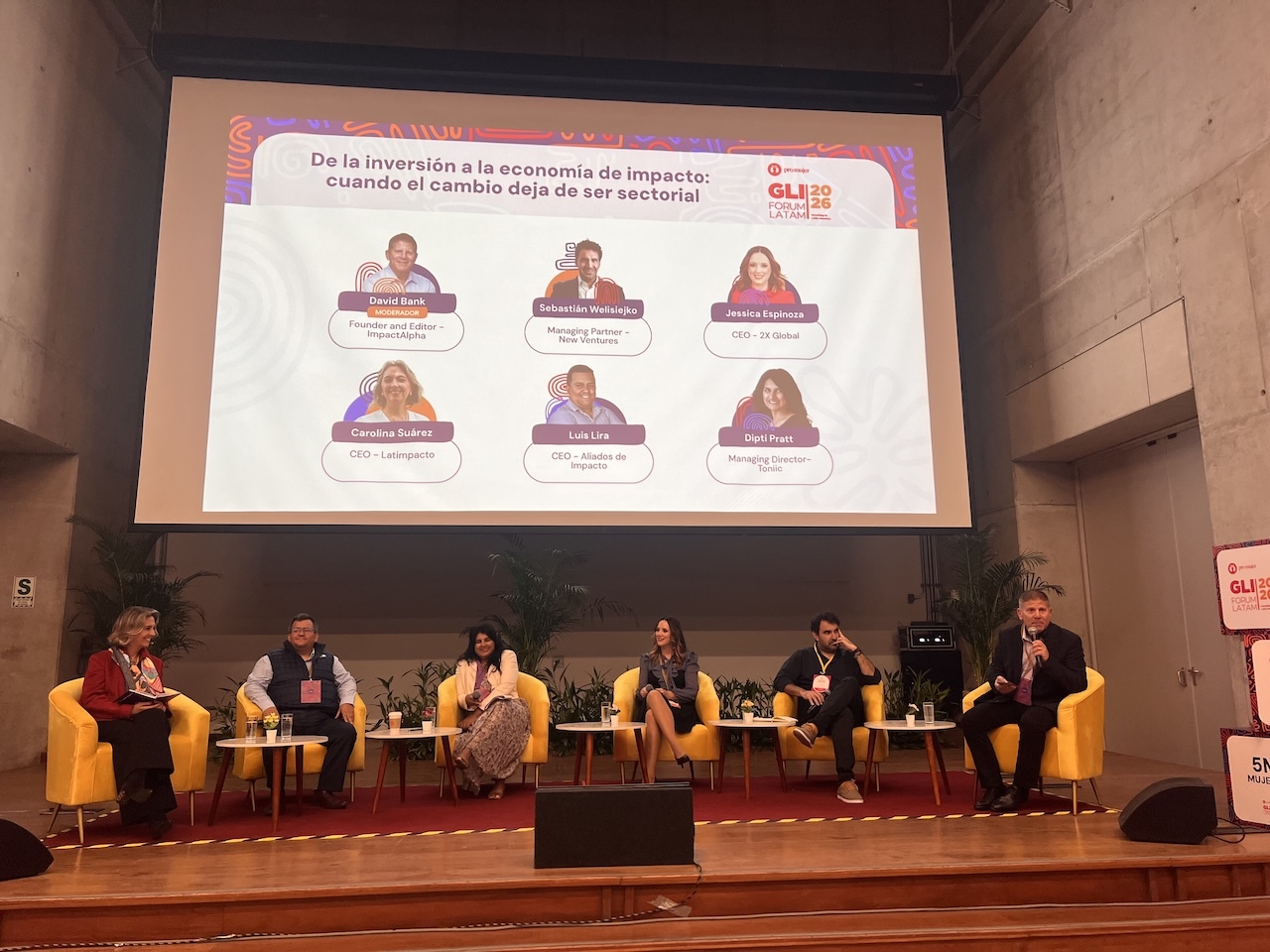
Espinoza told the story on the sidelines of this week’s GLI Forum LatAm in Lima, Peru, where the “alpha” in investments in, and by, women is taken as a given. Female fund managers, along with mixed teams, tend to outperform, as do companies with women’s leadership in management and on their boards, according to multiple studies (see, “The fundamentals of gender-lens investing are still ‘smart’”).
Female investors are two to three times more likely to invest in women as founders or entrepreneurs. And those operators are more likely to prioritize women as customers. Among fintech and microfinance lenders, for example, women are considered a better credit risk as borrowers.
“Women are the dynamic force in the economy,” Carmen Correa, head of Pro Mujer, which hosts the annual gathering of gender-lens investors in Latin America, told ImpactAlpha. “We need women in every stage and in every position. We need more women being able to participate at those tables where decisions are taken. We need more women in investment committees. We need more women investing. And of course, we need more women becoming entrepreneurs.” ImpactAlpha is the event’s media partner.
Competitive edge
Meeting those needs for more women in finance can also be a boon to fundraising. Espinoza said fund managers have reported that they have attracted new LPs as a result of the 2X global certification as “Good,” “Advanced” or “Best-in-Class.”
“It’s really a differentiator with the competitors,” Espinoza says. “Often, the first question we get is, ‘At what level are you certifying that competitor? What do we have to do?’”
2X Global is also getting in the business of certifying the gender aspects of green or social bonds. Organizations including Pro Mujer in Argentina and IIX in Singapore have issued “gender bonds” on public markets (see, “With gender bonds, Pro Mujer puts Argentina’s capital markets to work for female entrepreneurs”). 2X Global is positioning its criteria as an addendum to bonds issued under established labels. “We want to say any of these bonds can have a gender component,” Espinoza says.
At the company level, the 2X criteria can help companies upgrade their own operations. Aavance, which provides digital financial services in Colombia for Venezuelan migrants and returning citizens, stepped up its focus on the needs of women in order to meet the certification requirements. “It really transformed their way of doing business,” Espinoza said.
2X Global launched its third-party certification process at its global summit two years ago to bring transparency and rigor to the growing field of gender-lens investing. The lure is the throw weight of the institutional investors and other potential LPs who have signaled at least their intention to apply a gender lens to their allocations.
2X Global has its roots in the 2X Challenge announced at the G7 Summit in 2018, where development finance institutions from major countries set a modest goal of mobilizing $3 billion for gender-lens investments by 2020. The original development finance institution members themselves invested almost $7 billion and helped catalyze an additional $4 billion from other public and private investors.
That was just the beginning. Espinosa says the more and 150 2X members have so far directed $34 billion toward gender-lens investments, albeit under looser criteria than the group’s certification standards. The membership now includes pension funds, family offices and even commercial banks along with development finance institutions.
Demonstration effect
The lure of such allocations has many fund managers claiming to be “aligned” with 2X Global’s gender-lens criteria. Actual certification requires third-party assessments by auditing firms such as PwC.
“Any fund can slam gender onto their pitch deck, and that’s what they’re doing,” Espinoza says. “LPs were coming to us to say, ‘I want to invest in a fund that’s really doing great gender work. They’re all saying they are. Can you tell us which one is good, which one is better, which one is best?’”
Demand for the certifications from fund managers in emerging markets and even from commercial private equity firms in Europe has remained strong, Espinoza said. The exception, in the past year, has been fund managers based in the US.
“In the US, funds are more cautious because they are afraid of lawsuits, of being associated very clearly with the gender lens,” she said. “So they are doing the work, but they’re not talking about it, and they don’t want to get a certification.”
And to be sure, female fund managers continue to struggle to win mandates from institutional asset allocators. Women manage only a tiny slice of investment capital and, at least partly as a result, female-only founding teams attract less than 3% of invested capital.
“They are facing the same kind of hurdles as women entrepreneurs, where the LPs don’t allocate to them because of the presumed higher risk,” Espinoza said.
To help overcome such obstacles, 2X Global is getting into the fund management business itself. The 2X Ignite fund has raised $26 million, including from the German development finance institution KfW, Visa foundation and Global Affairs Canada, part of the government’s department of foreign affairs. The fund helps emerging managers “warehouse” early deals in order to establish the kind of track record that can attract investors.
The organization also manages the Resilient Futures Fund, a pool of grant money formerly known as the Gender Climate Equity Fund, previously managed by USAID. When that agency was decimated, 2X Global took on the management for the donors, including the Visa, UPS and Skoll foundations. Grants can go both directly to businesses, and to fund managers, as working capital, or to establish their dealmaking track records.
“We have raised our own vehicles to have that demonstration effect,” Espinoza said. “And then hopefully we won’t be needed anymore, because we’ve made the investment case, and then others follow.”