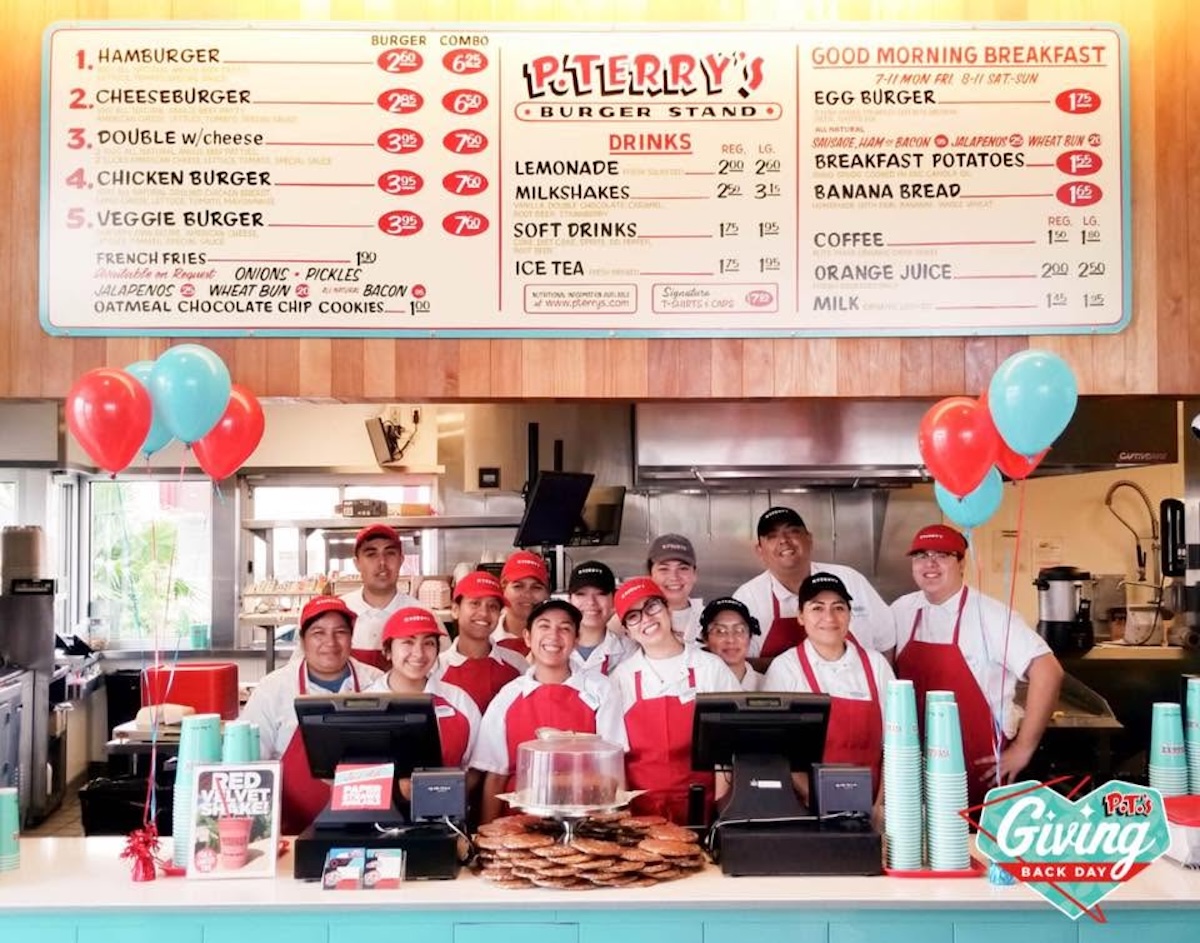

It was Patrick Terry’s childhood dream to own a burger stand. He and his wife Kathy opened one on a corner in Austin, Texas in 2005.
Two decades later, that stand has grown into a fast-food chain with 38 locations that employ 1,800 workers in the Lone Star State. Now, it is owned by those workers.
The decision to sell the company to their workers was Kathy’s dream, Patrick Terry told ImpactAlpha. “It’s been a labor of love for her. She’s been working on this for years to pick the right form of ownership.”
With support from Common Trust, the Terrys set up an employee ownership trust, or EOT, that will hold the ownership shares of P. Terry’s employees. The trust will share 5% of the company’s profits with longtime employees this year.
“Too often, the people who create the value are the last to share in it. We wanted to do something different,” Kathy Terry said. “We also wanted our team to feel ownership now — not someday. That’s why the profit-sharing plan matters so much to us.” P. Terry’s plans to grow the profit-sharing plan to 20% of the chain’s annual income over time.
Cultural preservation
The firm was almost sold to a strategic buyer 10 years ago. Said Patrick Terry, “We got a wonderful offer; a very more than fair offer from a very good company.” They held on to preserve the chain’s culture and reputation for quality fast food at an affordable price.
“P. Terry’s has taken a pioneering step that demonstrates that there’s another way to transition a company — one that protects its legacy, culture, and values,” said Common Trust’s Zoe Schlag, who is positioning employee ownership as “the leading strategy for businesses that want to stay independent and rooted in their communities.”
P. Terry’s says its burgers have no hormones and antibiotics, its buns have no high-fructose corn syrup and its pickles are kosher. The company has donated $2.8 million to local nonprofits since 2005.
“The people are really appreciative of what we do and how we do it differently than others,” Patrick Terry said. “I never imagined this. It’s wonderful to be P. Terry.”