

Critical and widely recognized social and environmental challenges, such as broadening access to economic opportunities and strengthening climate resilience, require bold, often capital-intensive solutions.
The price tags far exceed the current reach of the impact investing market.
For example, reaching the Sustainable Development Goals requires investments of $6 trillion annually in areas like facilitating universal access to digital resources, curbing pollution, and transitioning to sustainable food systems. That’s four times the total assets currently allocated to impact.
Rising to the occasion will require those deploying capital to think more broadly, including by being more intentional about how they leverage different asset classes to respond. Key to this is encouraging allocators to deepen their impact investing footprints in asset classes outside of the private markets. Private markets, long impact investors’ preferred terrain for greater influence and proximity to innovation, lack the scale necessary to meet the urgency and magnitude of today’s needs.
That scale lies primarily within the public markets, where larger amounts of capital can be mobilized to accelerate the uptake of proven solutions. From affordable housing to clean infrastructure to vaccine access, the future of impact lies in utilizing a toolkit that can drive both invention and large-scale execution, all while providing liquidity and competitive returns.
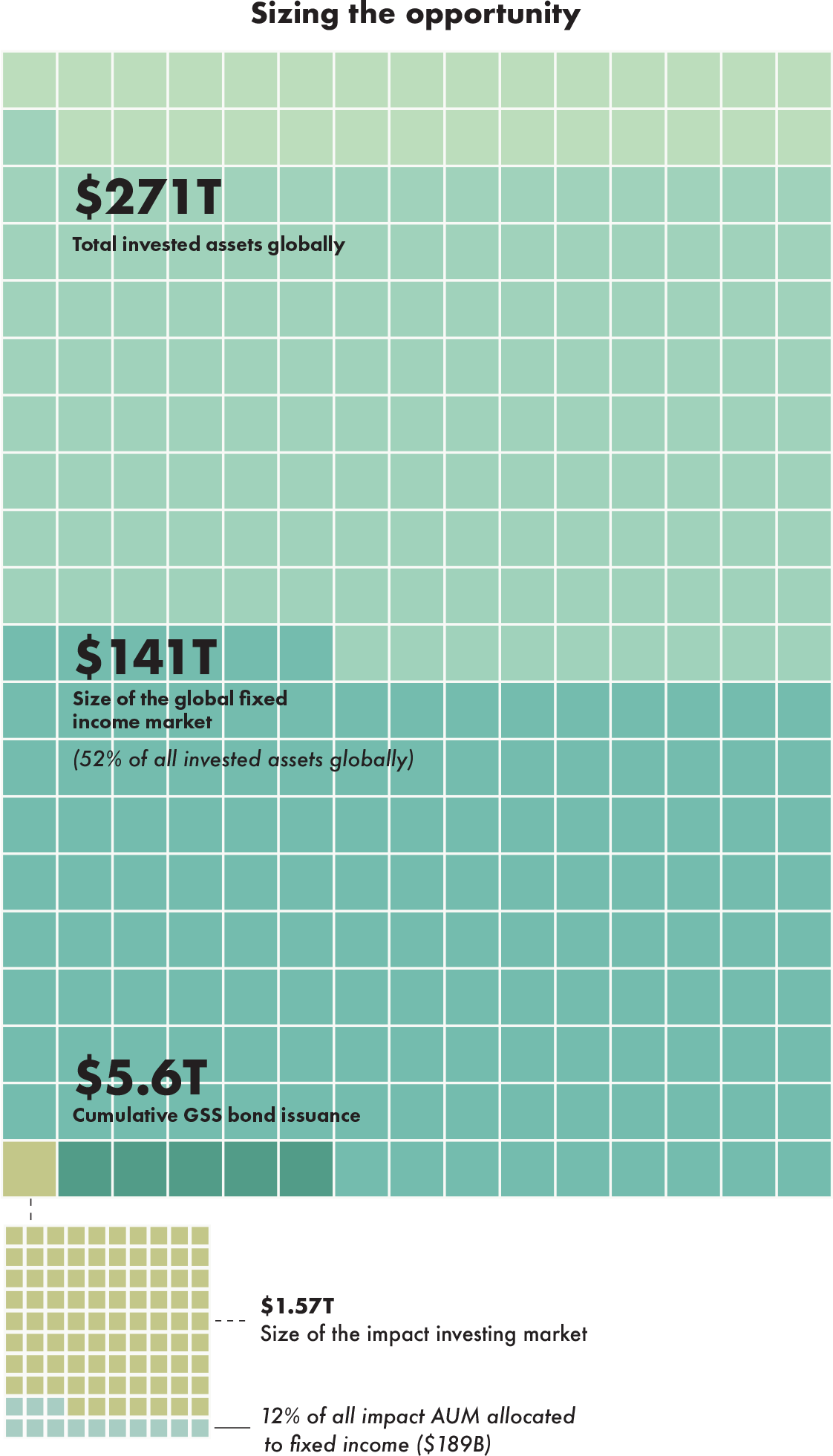
Enter fixed income: the financial markets’ asset class of choice for financing large-scale, capital-intensive projects. Sized at over $140 trillion, fixed income is easily the world’s largest asset class – comprising over 50% of global invested assets. Omnipresent in investment portfolios, fixed income has long been overlooked as an instrument of impact. Most investors value it for its predictable returns, not for its potential to drive positive social and environmental outcomes.
We make the case that fixed income deserves a fresh take in our new report, “Scaling Solutions: The Fixed Income Opportunity Hiding in Plain Sight.” The opportunity that this asset class poses is too big to ignore: Mobilizing even one percent of the fixed income market for impact has the potential to double the size of the impact investing market.
In Scaling Solutions, we offer six case studies that showcase strong impact fixed income strategies – from Community Capital Management, Edentree, Nuveeen, Schroders Blue Orchard, T.Rowe Price, and Wellington – alongside a practical toolkit designed to help asset owners and allocators incorporate impact fixed income into their impact mandates.
Power tool for the impact toolkit
Impact investors can approach fixed income with robust intentionality, contribution, and measurement. Our research also shows that investors do not have to sacrifice returns to seize this impact opportunity. A growing body of evidence shows that impact fixed income strategies can deliver strong, risk-adjusted financial performance while advancing meaningful social and environmental outcomes.
Fixed income is especially well-positioned to support impact solutions that offer both steady returns and reliable cash flow – balancing purpose with profit.
More fully harnessing the financial markets to address social and environmental challenges requires thoughtful, strategic deployment of capital across asset classes – each playing a unique function, or “utility,” as framed by The Investment Integration Project. Just as venture capital fuels high-risk innovation and public equities facilitate influence over corporate behavior, fixed income plays a critical but often underappreciated role. In Scaling Solutions, we make the case that fixed income can fulfill three key functions in support of impact.
Meeting urgent needs in real time. Fixed income is a go-to instrument for mobilizing capital to address time-sensitive challenges, thanks in large part to the high level of investor trust in the asset class and well-established infrastructure supporting issuance and trading.
Following the 2011 Tōhuku earthquake and tsunami – the fourth most powerful earthquake in recorded history – catastrophe bonds were instrumental to raising capital to support disaster relief. Issued by Munich Re, JA Kyosai’s catastrophe bond was able to raise USD $300 million for timely disaster payouts.
Mobilizing capital at scale. Fixed income is uniquely well-suited for raising significant amounts of capital to scale up proven solutions and meet big challenges — from funding public works to supporting national and regional initiatives. This is made possible by standardized debt issuance processes, global infrastructure that facilitates efficient trading, and strong institutional demand driven by the asset class’s appealing financial characteristics.
To finance its ambitious goal of achieving carbon neutrality by 2025, the government of Japan began issuing “Japan Climate Transition Bonds.” Proceeds raised via these instruments will fund projects including solar, wind, and thermal power generation, installation of high-efficiency water heaters within residential households, and the development of synthetic fuels.
Generating targeted and specific impacts. Fixed income provides investors a clear and upfront understanding of the impacts that they can expect to generate through their investments – with many having uses of proceeds that are clearly earmarked and impact labeling that comes with clear reporting expectations.
OneMain, a consumer finance company specializing in the provision of personal and auto loans to individuals with non-prime credit scores, reported lending over $560 million to women and minority borrowers (75% of its total borrower portfolio) in 2024. This was made possible via proceeds from its social bond.
Voluntary standards
In addition to these distinct advantages, fixed income offers impact investors access to a wide investible universe. From municipal and sovereign bonds to agency securities, asset-backed securities, and corporate debt, fixed income can be used to pursue impact outcomes across diverse sectors and geographies, while also hedging against financial risk.
This value is further strengthened by this market’s distinctive emphasis on integrity. Sustainability labels – such as “green,” “social,” or “sustainability” bonds – are supported by robust voluntary standards, offering investors an added layer of confidence and protection against impact washing. While there is work to be done to ensure labels are adopted with integrity and to enhance guidance on how to optimize for impact, the strong foundation these standards provide is undeniable.
Sustainability labels provide a helpful entry point for investors seeking fixed income opportunities aligned with social and environmental goals, but they are only part of the picture. We found that investors lack clarity about how to evaluate the impact potential of the broader universe of fixed income offerings, and, as such, are uncertain about how to credibly engage.
Encouragingly, our review of current practices among managers in this asset class suggests that widely accepted impact investing standards – such as the pillars introduced by the Global Impact Investing Network and the Operating Principles for Impact Management – translate well to fixed income. This means that impact investors do not need to reinvent the wheel: With some thoughtful adaptation, existing frameworks can provide a strong basis for navigating impact fixed income opportunities.
Tapping into impact fixed income
Impact manifests differently in fixed income than in private markets. With this in mind, we outline below criteria to evaluate the presence of the core impact investing pillars in a fixed income strategy.
| Impact pillar | Core characteristic of impact fixed income |
| Intentionality | Focus. Having a defined impact strategy in place that guides the selection of fixed income securities |
| Responsibility. Assessing issuers’ ESG practices and ensuring they do no significant harm as part of investment decision-making | |
| Completeness. Taking a holistic approach to assessing securities (i.e., considering stated uses of proceeds or revenue, issuer footprints, securities’ structure, and other sub-asset class and thematically specific factors) | |
| Contribution | Engagement. Optimizing the portfolio by leveraging impact measurement and opportunities to engage with issuers |
| Measurement | Transparency. Collecting, aggregating, and transparently reporting on the impact of investments |
Put simply, the market and tools exist for impact investors to start incorporating fixed income opportunities into their portfolios today. And critically, they can do so without compromising on performance, with impact fixed income strategies demonstrating the ability to deliver competitive, risk-adjusted returns alongside measurable impact.
As the impact fixed income market takes shape, early movers have a unique opportunity not only to drive measurable social and environmental outcomes, but also to influence the norms, standards, and ambitions that will define what we expect will be a period of rapid growth for impact investing in fixed income.
With these resources in hand, we say to investors: The time is now. Let’s get moving.
Joanna Cohen heads impact measurement and management at Builders Vision.
Sarah Gelfand is president of BlueMark.
Ngoc “Jade” Huynh is a senior associate at Tideline.