Summer 2020 marked a turning point for the US financial sector. The deaths of George Floyd, Breonna Taylor, and Ahmaud Arbery prompted investors to reflect on the industry’s broader role in fostering economic disparities and consider how capital markets could drive positive change. In response, many investment firms pledged to promote greater opportunity and inclusion within their organizations and portfolios.
Nearly five years later, progress has been limited. In 2023, funding for diverse entrepreneurs hit its lowest level since 2016, and leadership in asset management remains overwhelmingly concentrated in a small demographic group, with nearly 99% of all assets under management controlled by a narrow segment of the population. Furthermore, investors seeking to expand access to capital now face additional legal and regulatory challenges related to targeted programs aimed at fostering economic mobility.
While inaction and uncertainty paint a grim picture of the strategic practice of what we call “racial equity lens investing,” it is an incomplete one. In the second half of 2024, The REAL and Tideline, with additional support from Community Capital Advisors, collaborated to check the pulse of the market for racial equity lens investing. In doing so, we surveyed investment consultants, institutional asset owners, data providers, and investor network organizations, asking the question: what would it take to help investors to continue moving progressively from commitment to action?
What we found was assuaging. Many investors across the capital spectrum remain active and committed to advancing equity over the long-term – not in spite of, but because of, likely resistance and retrenchment that lie ahead. We also asked what resources were missing in the field to support investor institutions that are actively deploying capital for equity and justice.
The answer was loud, clear, and unified: the field already has many excellent tools that contribute to making racial equity lens investing as accessible as possible, from providing financial casemaking data on investing in diverse managers, to roadmaps for supporting investors across institution types, to benchmarked data on corporate diversity to support informed investment decision-making.
Breaking down silos
What is missing is a more coordinated effort to break down silos among different investing institutions. Endowments speak to other endowments. Commercial asset managers speak to other commercial asset managers. Insurance companies speak to insurance companies, and so on within various fields of practice. They arrive at their own common understandings and visions of what a more racially just society and economy look like, curate their own resources, and exchange lessons learned and best practices among themselves.
While organizing at this peered scale is necessary and important, we found that the absence of conversation between these groups and higher-level coordination overall was a critical market gap.
There was agreement that racial equity work is more important now than ever, but also a need to clearly state “why.” Why is racial equity lens investing important, what would a shared vision for the market be, and how can investors work together to achieve it across their respective fields of practice.
More clarity is needed on what effective investment practices entail; how existing resources from different investor communities can be shared, adapted, and sequenced; and how different investor types can collaborate to achieve equitable access to capital in a more effective and sustainable way.
Amid legal and regulatory challenges, an absence of collective discussion and organizing creates friction and puts individual investors, managers, and the practice of racial equity lens investing at risk. Progress suffers from atomization and isolation, making networks that organize common resourcing and build community for investors as a group (for example, the Freedom Economy), essential. Similar coalescence is needed outside of the legal context to advance investor practice, first through alignment on a common definition of what racial equity lens investing is, and on what characteristics are expected of investors seeking to adopt it with authenticity.
Common language
To kickstart the process, The REAL and Tideline have created a first draft of what a foundational definition of racial equity lens investing and investor characteristics could look like for those committed to the approach.“An applied investment philosophy through which investor policies, practices, behaviors, and capital allocation strategies are critically examined with respect to the systemic exclusion of racialized people and communities and are reconfigured with the aim of creating a capital system that contributes to inclusion, repair, and regeneration.”
What this draft implies is the need for committed investors to be united in exhibiting a high degree of self-awareness, conviction, and intentionality. The expectation is for these investors to undertake the long and unglamorous process of rooting out bias within their policies, processes, culture, and governance. To choose to be a racial equity lens investor is to acknowledge how racial inequity permeates the global financial system and to do the incremental, internal work of reimagining a system that works for everyone.
Visible versus immersive
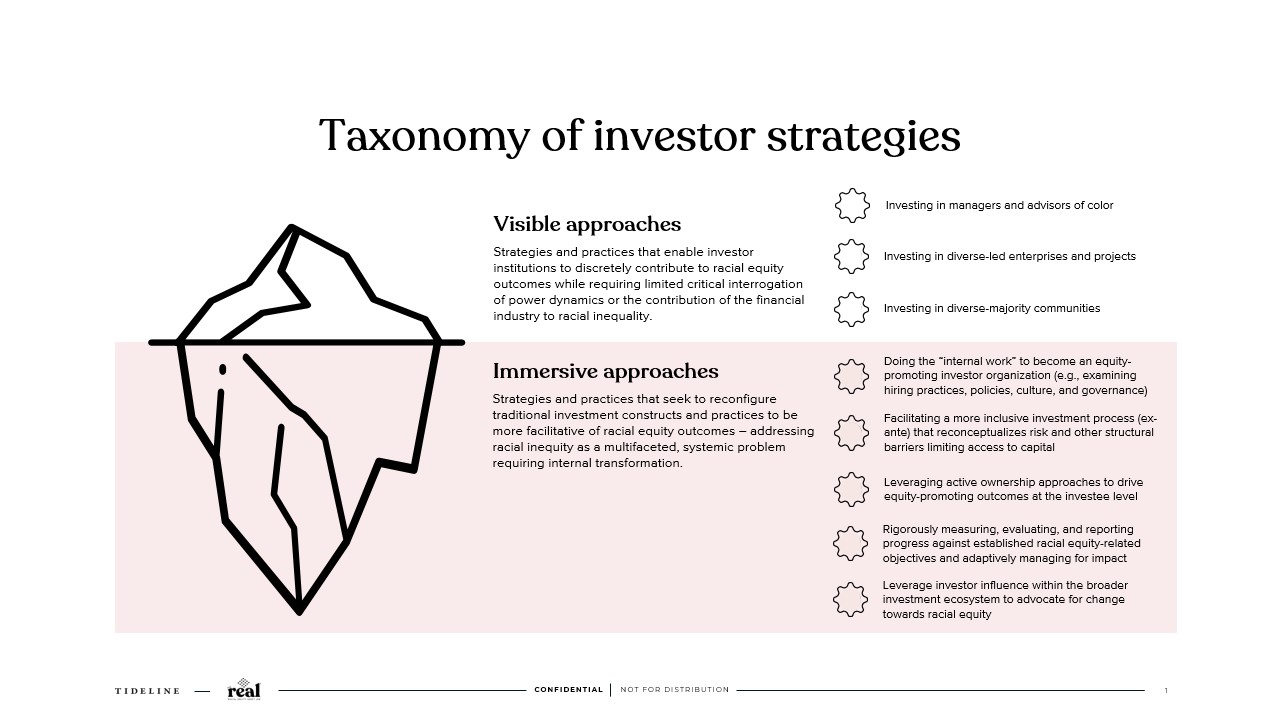
Based on this premise, the universe of actions investors can take to advance equity can be classified as “visible” or “immersive.” The “visible” encompasses strategies and practices that enable investors to contribute to racial equity outcomes even without critical interrogation of power dynamics or the contribution of the financial industry to racial inequality.
In contrast, strategies and practices classified as “immersive” are those rooted in analysis that treats racial inequity as a multifaceted, systemic problem requiring deep, internal transformation. We provide examples of actions for both approaches below, with insistence that they both are critically important. However, while doing the “immersive” work enhances “visible” approaches’ efficacy, comparatively few investors committed to advancing racial equity are looking beneath the surface.
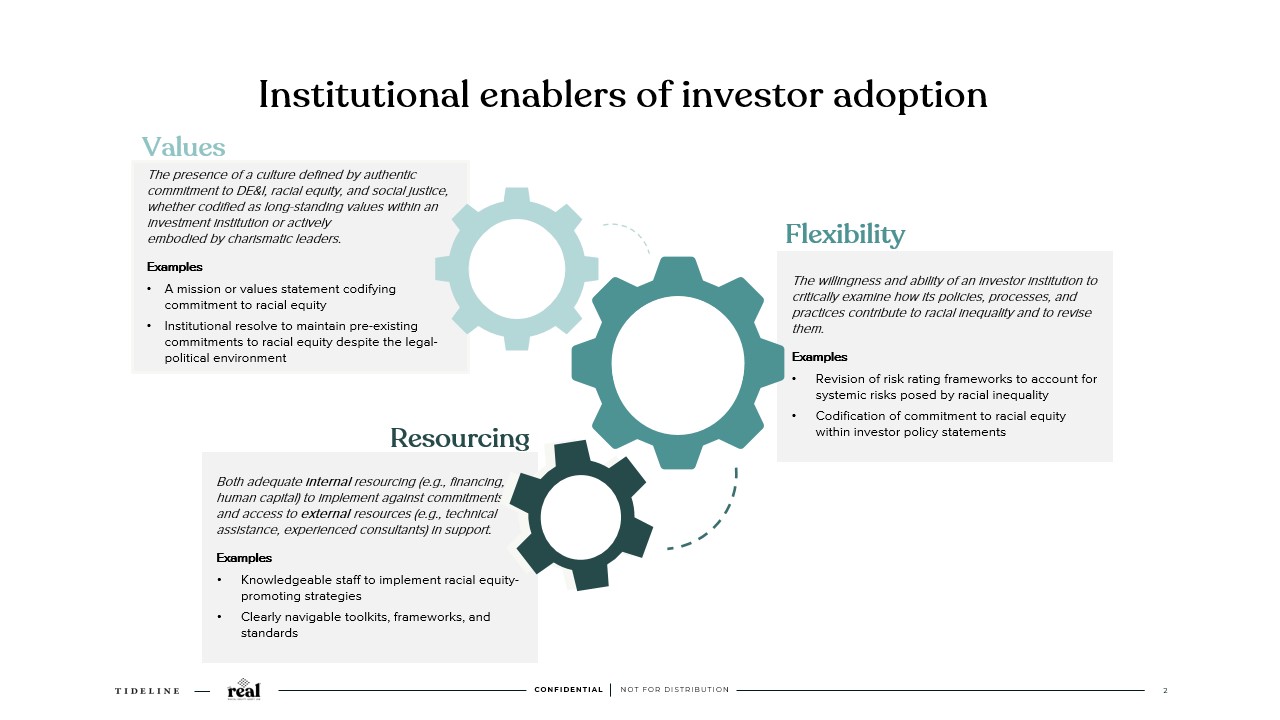
We recognize that pursuing “immersive” actions is a tall order – requiring, based on our research, three levers to be in place. First, an investor needs to have values related to racial equity and social justice, whether embodied institutionally via a mission, vision, or other key infrastructure. Second, an investor needs to have the flexibility to review and revise its ways of working, often through a culture of learning and growth. Finally, an investor needs access to the internal or external resourcing – budgets, expertise, guidance – to translate commitment into action.
Moving ahead
Our hope in sharing these findings is three-fold.
First, to invite field-level discussion on where racial equity lens investing is headed.
Second, to clarify what is practically needed for committed investors to participate in racial equity lens investing with the hope of making entry more accessible for newcomers.
And third, to provide a path forward for those who feel stuck in their approaches or discouraged by the current environment.
The work can and must urgently continue, with the goal of creating a financial services industry that truly serves every corner of society as an engine of shared prosperity. To achieve this goal, it will be important for committed investors to stick together as a collective, shine a light on each others’ work, and collaborate.
Erika Seth Davies is the founder and CEO of The REAL and Rhia Ventures. Jade Huynh is a senior associate at Tideline. Bert Feuss is a senior advisor at Community Capital Advisors.