

By the end of this fall’s Denver gathering of the philanthropy network Grantmakers in Aging, it’s possible a few more foundations will choose to be known also as Impact Investors in Aging.
The nearly 150 foundations in the network represent nearly $45 billion in assets.
“We want to get all those folks,” says Peter Kaldes, who heads Denver-based Next50, the private foundation that is hosting the October conference in part to make impact investing a major agenda topic. “We think we have some who will follow along and really help change how we view aging and how we invest in aging.”
Next50, with an endowment of approximately $265 million, is on its own journey to align 100% of its assets to value and support aging. The foundation was established in 2016 with the proceeds from the sale of InnovAge, a Denver-based senior care operator.
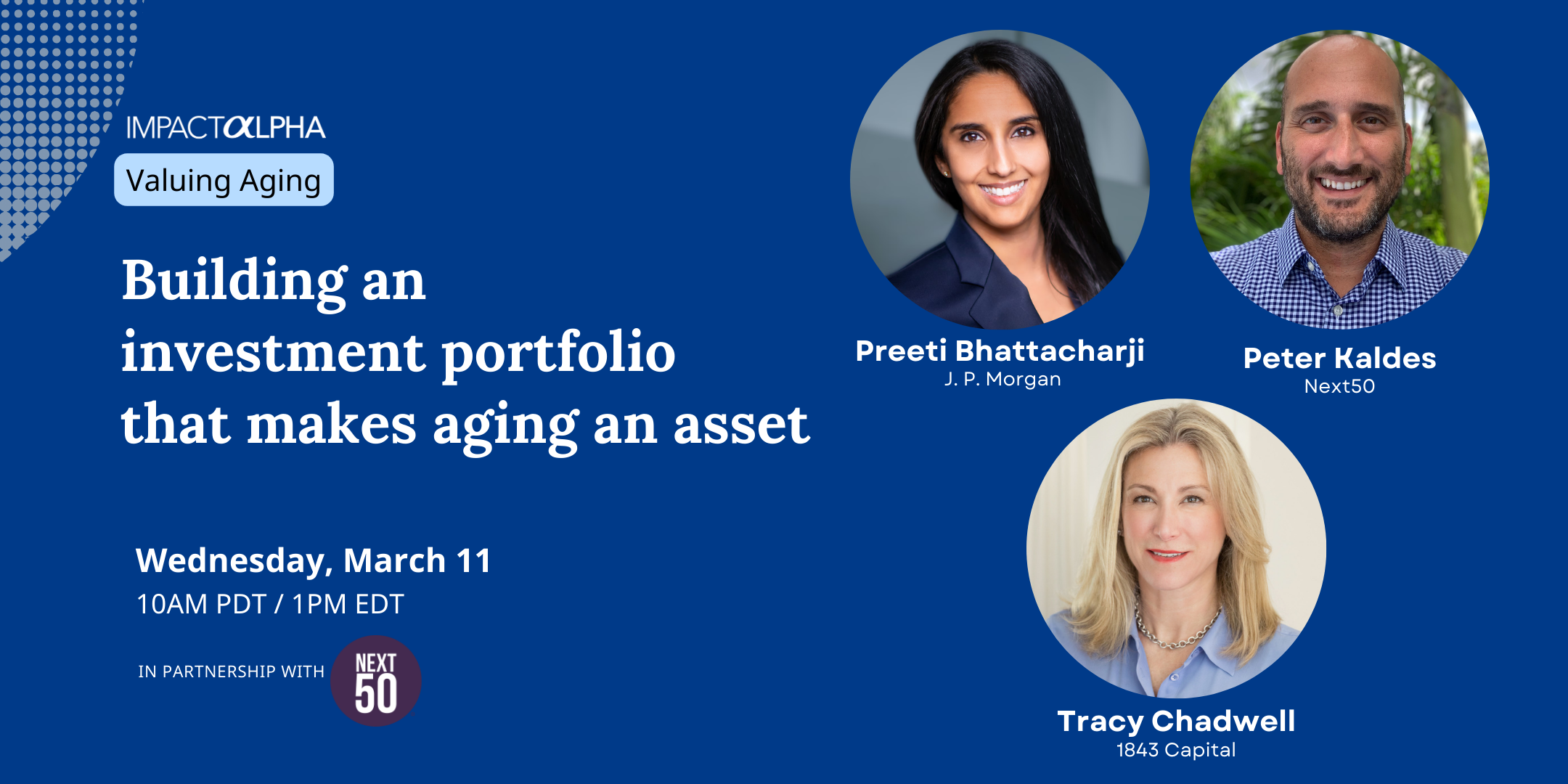
Kaldes will join this Wednesday’s Agents of Impact Call to present Next50’s “aging investment framework,” which sorts opportunities on a spectrum from age-friendly to age-inclusive to age-centered (RSVP now). ImpactAlpha and Next50 are partnering to expand coverage of investment opportunities in healthy aging, and to chronicle the foundation’s efforts to align its endowment investments, across asset classes, with its programmatic mission to value and support aging.
Already, more than 123 million Americans, or 36% of the US population, are over 50. They support nearly half the jobs, and generate 60% of the tax revenue. Globally, the population over 50, with $10 trillion in consumption, represents what could be the third-largest economy in the world. That’s a massive and largely untapped investment opportunity.
“It’s a new way of thinking about an age-old problem,” Kaldes tells ImpactAlpha. “It’s not like we didn’t know this was coming. It’s not like we didn’t know that we’re going to need capital to bolster the infrastructure around us as we age.”
Essential products and services
Kaldes enlisted JPMorgan Chase’s private bank to build a portfolio approach not only for Next50, but for the bank’s other clients as well. The bank now offers “support aging” as a thematic “cause,” or lens that can even be combined with other causes, such as climate action, women’s leadership or racial equity and applied across public-equities and fixed-income portfolios.
“We are already talking to hundreds of millions of dollars worth of clients that have expressed serious interest in the cause,” says Preeti Bhattacharji, who heads the sustainable investing practice for JPMorgan’s private clients.
Bhattacharji will join The Call to walk through the process of constructing a portfolio around not just older adults, but the process of aging itself (RSVP). In: Grocery delivery services and other goods and services that help older adults affordably “age in place.” Out: Anti-aging creams and other live-forever products that frame aging as a problem to be solved.
The approach “is really designed to support aging by investing in a corporate world that values older adults’ participation in the workforce, exercises responsibility and non-discrimination in its dealings with older adults and provides essential products and services to ensure well-being throughout the aging process,” Bhattacharji tells ImpactAlpha.
To assemble the roster of investable companies, the JPMorgan team asked three questions: Is this company providing good products and services to older adults? Is this company a good employer for older adults? And, is this company causing harm to older adults?
Organizations like the Age Friendly Institute certify the best places to work for people over 50. Violation Tracker, a project of Good Jobs First, surfaces federal, state and local violations, including for example, findings of age discrimination in hiring practices. Such data has only rarely been used to guide investment decisions.
“One of the main ways in which employers harm older workers is with all kinds of financial shenanigans in their pensions and their retirement accounts,” Bhattacharji says. “The main way in which companies can support older workers is by appropriately funding their retirement accounts.”
The push to value and support aging is an antidote to narratives of decline and disability, as well as to paternalistic attitudes that may serve to disempower older adults.
“Supporting aging isn’t about deciding what’s best for aging people. It’s giving them the tools in their lives to make those own decisions for themselves,” says Kaitlyn Sanches, part of JPMorgan’s OpenInvest team, who helped build the screen. “You get to call the shots in your own life. You have the power to live well and live the way you choose.”
LP/GP
A handful of private foundations already are expanding their financing toolkits with impact investments. In the UK, the Vivensa Foundation, formerly the Dunhill Medical Trust, has set out its own impact investing mandate for its £170 million ($228 million) endowment.
The SCAN Foundation, based in Long Beach, Calif., invests in supportive services, like care in the home or affordable housing, as well as in “age-tech” for aging well.
“Older adults are not a niche for impact investors,” SCAN’s Brendan Ahern and Xenia Viragh wrote in a guest post on ImpactAlpha last year. “They are the future: a growing demographic whose needs will reshape the economy, from health care and housing to financial services and caregiving.”
The next step in Next50’s journey to 100% mission-alignment of its endowment is to complement its public-equities and fixed-income portfolios with investments in private equity, venture capital and other private-market assets.
Next50 is an LP in Washington DC-based 1843 Capital, which is focused on the changes needed in social infrastructure to “solve for the 100+ lifespan,” as the firm puts it.
“Marketing to seniors is the worst approach to engage older adults,” says 1843’s Tracy Chadwell, who also will join this week’s Agents of Impact Call (RSVP).
1843 Capital invests across aging and longevity tech, in more traditional areas like caregiver solutions to non-obvious categories including autonomous mobility. Several years ago, 1843 backed May Mobility, an autonomous driving vehicle company with one of the only wheelchair-accessible autonomous vehicles in its category. Last year, May inked a large partnership with Uber.
Among the VC firm’s other notable investments are Beautycounter (exited for $1 billion), MIDI Health (worth more than $1.1 billion) and Function Health (with a $2.5 billion valuation).
Next50 is also invested in Age1, co-founded by Laura Deming, who had earlier run the Longevity Fund, and Alex Colville, an aging-focused biotech investor. Age1 invests in therapeutics for aging-related diseases and in machine-learning platforms that advance drug discovery related to aging. Age1 raised $35 million in 2023.
US-based aging-focused fund managers include Minnesota-based Relentless Pursuit Management’s Relentless Venture Fund, which has backed at least eight startups to optimize access to a continuum of care, including medical data company Canary, disease prevention startup Newtopia and virtual care platform Snapclarity (acquired by CloudMD).
In Canada, PHC Ventures, the investment arm of Vancouver-based Providence Health Care, has invested in a raft of Canadian healthcare startups including medical device company Total Flow Medical, healthcare revenue management firm SapienSecure and biotech VoxCell.
In Latin America, DB Lab, the venture arm of the Inter-American Development Bank, along with Colombia-based Fundación Arturo Sesana, have launched Región Plateada, or “silver region,” To find solutions for healthy aging. By 2050, more than one-quarter of the region’s population will be over the age of 60, according to the Inter-American Development Bank.
“Care systems are being stretched,” said Región Plateada’s María Andrea Orduz. “If you help older adults access services and prevent dependency, you can improve quality of life and reduce long-term costs for families, health systems and governments.”