With their supply chains, their manufacturing and their operations, family business leaders in Hong Kong, Korea, Singapore and other economic hubs in Asia are seeking to future-proof their businesses and the communities they serve.
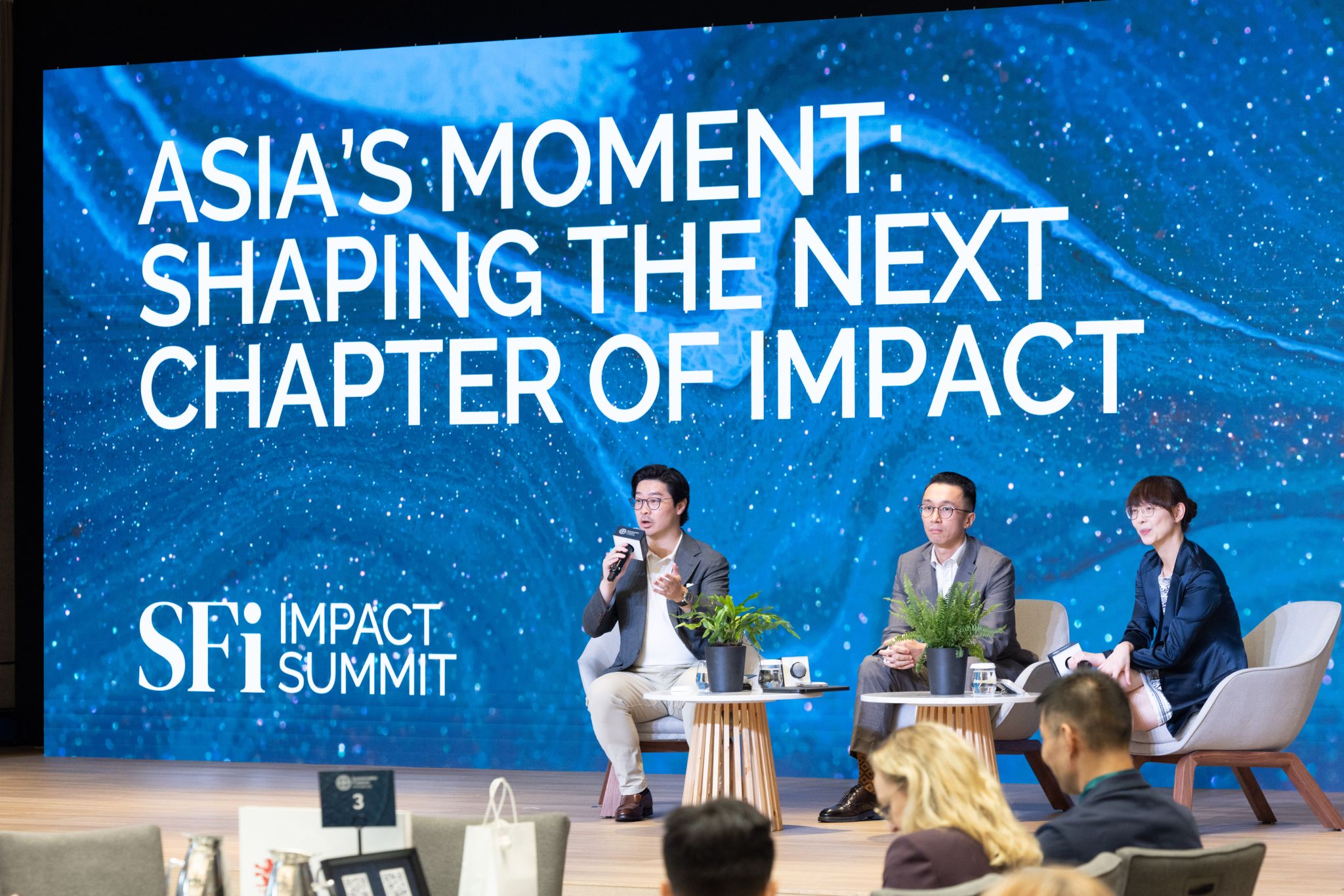
“We believe family businesses will ultimately play a central role in the capital stack behind impact in Asia, given their multi-generational perspective, tolerance for complexity, and deep roots in the real economy,” Hareesh Nair, chief investment officer of Tsao Pao Chee Group, said at the SFi Impact Summit, an annual gathering of Asia-based asset owners hosted by Sustainable Finance Initiative in Hong Kong.
Nair says TPC, the Singapore-based family investment holding company rooted in maritime logistics and industrial supply chains, deploys the business, investment, advocacy and philanthropy as complementary levers to drive impact at scale. “As a fourth-generation family business, we believe long-term relevance requires adaptation, and this means preparing business for a world evolving beyond industrialization toward greater human and planetary well-being,” he says.
In Hong Kong, Carissa He is helping her family’s manufacturing business, Actmax, reduce carbon emissions, cut material waste and improve supply-chain sustainability.
“Corporations sit in a sweet spot between customers and consumers, the supply chain and the manufacturers, and also the government and regulation,” she said. “If the end goal for me was how can I create greater impact and leverage what I have, family business was the right decision.”
In Korea, Kyungsun Chung, grandson of late Hyundai group founder Chung Ju-yung, is helping Hyundai Marine and Fire Insurance tackle social and environmental risks before they become liabilities.
“We were more of a passive risk mitigator [before],” said Chung, who has pushed the company to engage the government in proactively addressing Korea’s youth mental health crisis in an effort, in part, to stem claims for children. “This kind of preventative method, not just for healthcare but for prevention of climate damages and other things, could make an insurance company much more sustainable.”
Pulse check
Asia accounts for nearly one in five of the world’s 500 largest family-owned enterprises, which generate $8.8 trillion in annual revenues.
Nearly a third of the 300 or so asset owners at the SFi Impact Summit say they have more than half of their assets invested for impact or sustainability already, according to a live poll conducted at the event. More than 90% are focused on opportunities in the Asia-Pacific region. In emerging markets, there is growing interest in Africa. Food and agriculture, and oceans, were the top two investment themes.
Even as interest in impact investing grows, some Asian family businesses remain reluctant to engage, said Angel Chia, who leads the Hong Kong Academy for Wealth Legacy, a government-backed organization established to support family offices and help families build long-term legacies.
“If the business is okay, then why rock the boat? If the business is in a challenging situation, then we’re patching it up,” Chia told ImpactAlpha, describing the mindset she often encounters among family enterprises. The Academy works to bridge that gap through education, convenings and exposure to philanthropy and impact investing.
Chia sees the Academy’s role as creating the conditions for families to begin their own impact journeys through education, convenings and exposure to new ideas. What spurs families to make their first impact investment? “It’s a book, it’s a talk, whatever personal thing. I’ve seen it again and again. It is something that has to happen inside,” she said.
For Annie Chen of Hong Kong family office RS Group, the question is no longer whether impact investing works, but where capital can be most catalytic.
“We’ve demonstrated that you actually could deploy across the portfolio,” said Chen. “The next step for us was: where do we want to have a deeper, more focused impact, and how do we do that?”
Chen announced the creation of a new program to support nature-positive, early-stage ventures and funds through offering different types of patient and flexible impact-first investment capital. This program is funded by a dedicated pool of philanthropic capital, free from the requirement to generate financial returns.
“That means that we can take more risk,” said Chen.
The term “impact investing” still carries the connotation of financial trade-offs for many wealthy families in Asia. Chen encourages her peers to think instead in terms of “consequences” of how they do business and how their money is put to work.
“Financial performance is just one of the consequences,” she said. “I think of it as trying to bring us to a kinder, gentler system.”
Operator mindset
Chii-Fen Hiu, who directs the Singapore-based Centre for Impact Investing and Practices, said many Asian investors are already pursuing impact-oriented strategies, even if they do not use the label. “When we describe what impact investing really is, they basically said, ‘Hey, we’re actually doing that, we just haven’t called it that,'” Hiu told ImpactAlpha.
The center was established by Temasek Trust in 2022 to help build the market infrastructure for impact investing in Asia. CIIP recently surveyed 165 funders representing more than $1 trillion in assets and found climate adaptation and resilience was the top impact theme in Asia. The biggest challenge? “Resoundingly, it was pipeline,” said Hiu, reflecting on the need for coordinated cross-sector action to overcome barriers in this space.
Hiu argues that the region’s distinctive contribution is its focus on integrating impact into core business strategy and long-term stewardship. “The narrative around impact investing is less around being a side piece, but really around integrating that into core business strategy and business imperative objectives,” she said.
Sam Richards of Sydney-based Brightlight said the close links between business operations and capital allocation position Asia’s family businesses to scale their impact.
“The pragmatism and the intersection point between the family business and the portfolio is both initially a blockage for action, but also a profound opportunity once it clicks,” Richards told ImpactAlpha. “The language for moving money in this region is about harnessing the pragmatism. Don’t fight it, harness it.”
The family office clients of Pictet Group, a trillion-dollar wealth manager based in Geneva, increasingly see sustainability as a lever for resilience and growth, said Pictet’s Marie-Laure Schaufelberger. Rather than treating impact as a separate allocation, many of the region’s family businesses are integrating sustainability into their core operating and investment strategies, she says.
“The families that care about impact and sustainability here at the summit, care about it deeply, are increasingly sophisticated,” Schaufelberger told ImpactAlpha.
Schaufelberger said geopolitical tensions are prompting investors to reconsider concentrated exposure to US markets and seek greater diversification. That shift could create new opportunities for Asian markets and sustainability-focused investments.
“Long term investors are reframing the risk-return equation,” she said. “If you start to think about risk differently, you will construct your portfolios differently, creating new opportunities.”