

A well-functioning democracy creates the foundation for long-term economic stability, resilient markets and effective institutions — all conditions that support sustainable value creation over time. As investors recognize the connection between strong public systems and economic performance, a new lens on impact opportunities is emerging that includes civic infrastructure, institutional trust and democratic participation.
Clients who care about education, climate, health and many other long-term priorities, recognize that progress on these issues depends on healthy democratic systems. For advisors, this is an opportunity to meet clients where values, risk and market relevance intersect.
At CapShift, we’ve seen increased client demand for solutions that strengthen democracy. To translate that into portfolio construction, we’ve developed a framework for understanding where private capital can strengthen democracy and the key forces that contribute to democratic resilience.
What does the democracy investment landscape look like?
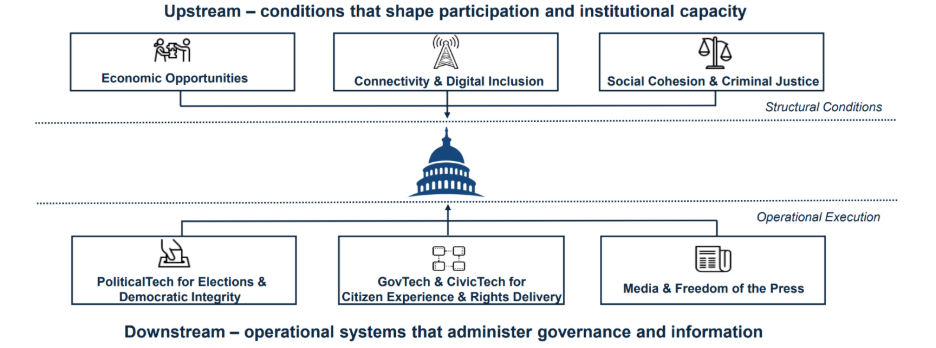
It is helpful to separate the democracy investment landscape into two interdependent layers:
- “Upstream” solutions are those that create the structural conditions that shape democratic participation and institutional capacity.
- “Downstream” infrastructure refers to the operational systems that administer governance, elections, public services, rights delivery and information flows.
Upstream determinants include areas like economic opportunity, connectivity and digital inclusion, social cohesion and criminal justice. These are generally larger and more familiar markets, and they often overlap with sectors clients already understand. Compared to pure-play democracy infrastructure, upstream solutions represent a deeper and more scalable opportunity set, though return profiles vary by strategy and capital.
Downstream infrastructure encompasses technologies and systems that support elections and democratic integrity, citizen experience and service delivery, and media and freedom of the press. This is a more specialized part of the market that can be harder to navigate. As a result, investments in downstream infrastructure may require more careful matching between opportunity type and capital structure.
In practice, the two layers are closely linked. Upstream conditions shape who can participate and how much capacity institutions have to serve the public. Meanwhile, downstream systems determine how reliably elections, public services and information flows operate in practice. Democratic performance depends on how well these systems reinforce one another — which is why investment opportunities across both layers should be evaluated together rather than in isolation.
The two layers of democratic infrastructure
What is driving the opportunity?
Three forces shape the strength of a democracy: institutional trust, access to public and economic systems, and information integrity. Each point to a different set of investment needs.
1. Trust in institutions
Trust in institutions affects how the economy functions. In 2025, only 17% of Americans reported trusting the federal government to do what is right “most of the time,” down from 22% in 2024 and 35% in 2005. Increasing trust can allow governance to become more effective: Policies are easier to implement, compliance can improve, and public spending may have greater impact.
Service delivery is one place where this shows up. Clearer digital platforms for election information, benefits navigation, and public-service delivery can help citizens find and access information and services — and engage with government more easily.
For investors, the relevant opportunity is the infrastructure behind better service delivery. This includes tools that support benefits navigation, case management, constituent engagement and workflow modernization. Companies that build more transparent, accountable, secure and reliable systems may be better positioned to sustain adoption across political and regulatory cycles, particularly when their products are embedded in essential public workflows.
2. Access to civic and economic systems
Another area of opportunity is access. Structural barriers can prevent individuals from fully participating in civic, political and economic life. These barriers show up directly in elections and public services: While the 2020 election saw voter turnout increase to 66%, participation remained uneven, with only 47% turnout among eligible voters ages 18 to 29. Beyond elections, gaps in public benefits access remain significant, with nine million adults over 65 eligible for but not enrolled in programs that would help cover the cost of food, medicine and other expenses.
Access is not only about whether someone can vote or navigate public services. It is also about whether people have the stability, resources and connectivity to participate more fully over time. That includes affordable housing, small business finance, workforce pathways, healthcare and other conditions that support civic, political and economic participation. Strengthening these conditions can expand participation over time.
3. Misinformation, influence and information systems
The digital information environment has become a major destabilizing force for democracy. Platform algorithms can amplify polarizing content, while local information ecosystems continue to erode. Roughly 2,500 local newsrooms have closed over the past decade, leaving more than 50 million Americans with limited access to credible information about their communities.
This creates two areas with different investment needs: technology and independent media. Tools that detect misinformation, verify content, show where content came from, and support AI governance may be able to scale through enterprise or public-sector customers.
Local news, press freedom and community information systems often need philanthropic, concessionary or blended capital because their revenue models are usually too constrained for market-rate capital alone.
How can different investors participate?
Capital across the spectrum has a part to play in strengthening democracy. Market-rate returns may be found in larger upstream markets, government technologies, broadband, digital infrastructure and select information-integrity strategies. Philanthropic dollars and blended-capital structures can be especially important in parts of the market where commercial capital alone may be less effective, including local media, press freedom, early-stage civic technology and community information systems.
It’s worth noting that the investable universe is much deeper upstream than downstream. As a point of reference, CapShift’s Research Engine includes 400+ democracy-adjacent opportunities, compared with 20+ strategies focused on core democratic infrastructure. Downstream strategies can be highly relevant to democratic resilience, but they are often smaller, more specialized and more sensitive to capital structure.
Allocating investments with a democracy objective requires a degree of complexity. Targeted interventions work best when engaged across the layers of upstream determinants and downstream infrastructure. This may also mean pairing market-rate investments with concessionary or catalytic capital.
Financial returns and impact may also move on different timelines. Clients with fixed return expectations or narrower mandates may need to focus on the parts of the landscape where the capital structure, revenue model and impact objective are already aligned.
Investing in democracy as infrastructure
Democracy is infrastructure that requires continuous investment and maintenance. This is not a conventional market. Returns will likely be uneven and timelines significantly longer.
But demand for solutions is growing among clients, and the broad-reaching benefits of improving public-systems function is hard to argue with as institutional trust comes under pressure. This complexity makes advisor judgment central as clients look to invest in democracy.
Cynthia Desmet Villar is an impact investing associate at CapShift.
Advisors’ Corner is a content partnership between ImpactAlpha and CapShift. CapShift’s impact investing platform empowers financial and philanthropic institutions — and their clients — to invest in their vision for a better tomorrow. All content is solely for informational purposes and should not be used as the basis for investment decisions.
Guest posts on ImpactAlpha represent the opinions of their authors and do not necessarily reflect the views of ImpactAlpha.