We often talk about impact investing as a strategy. What increasingly excites me is the larger question: What does it actually take to build an impact economy?
At its core, an impact economy is not simply about investors deploying capital differently. It is about how capital, policy, philanthropy, entrepreneurship, communities, and financial institutions interact to shape outcomes together.
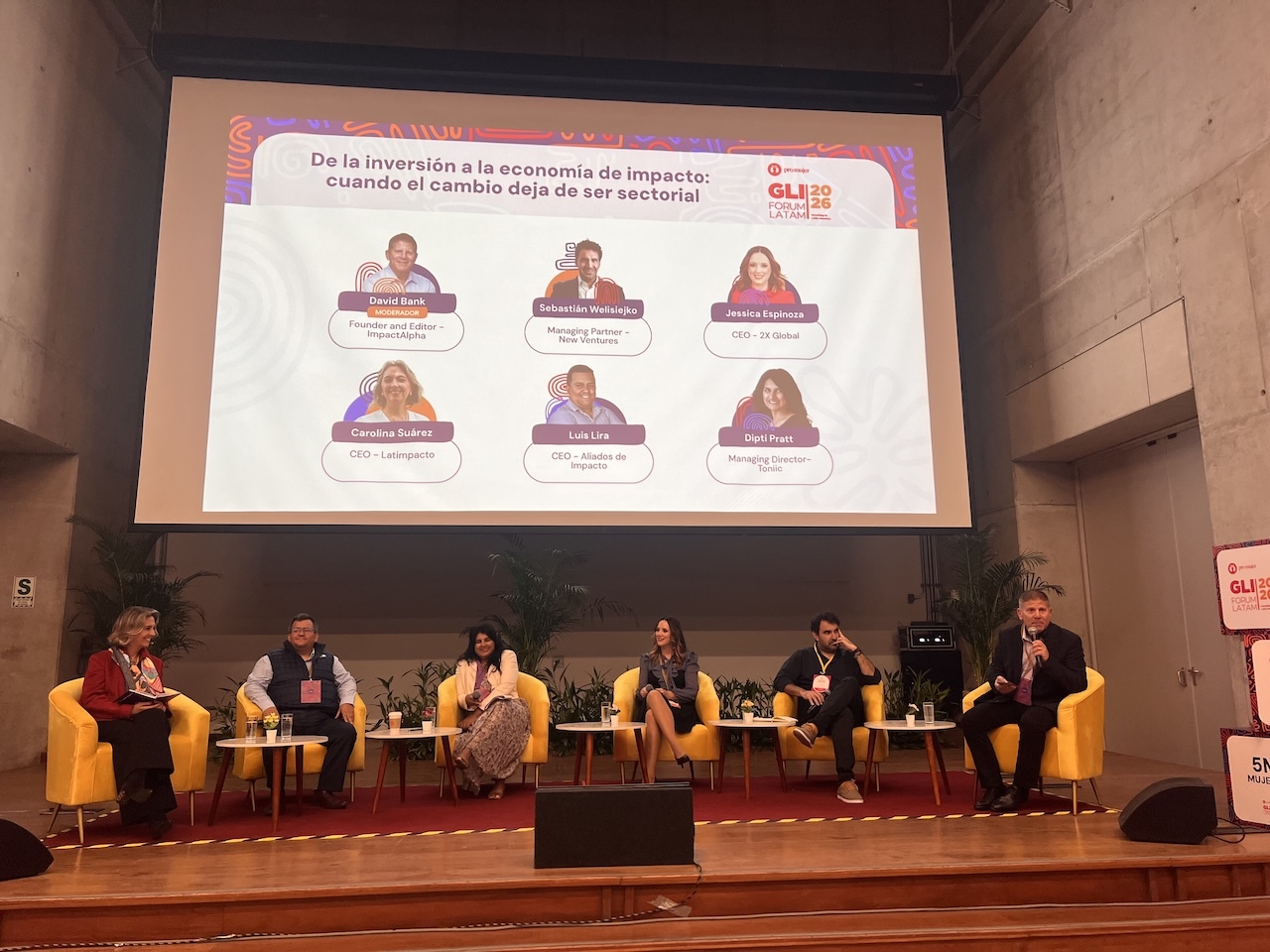
That was the focus of a recent panel I joined at Pro Mujer’s Gender Lens Investing summit in Lima, Peru, alongside New Ventures’ Sebastián Welisiejko, 2X Global’s Jessica Espinoza, Latimpacto’s Carolina Suárez and Luis Lira of Aliados de Impacto, moderated by David Bank of ImpactAlpha.
What was especially powerful is that the panel itself reflected the ecosystem we were discussing. Each organization represented a different function within the broader impact economy: gender lens investing, ecosystem coordination, investor mobilization, regional network building, and narrative shaping. Together, the conversation highlighted how much durable outcomes depend on coordination across actors, not isolated effort.
At Toniic, we often describe our role as connective tissue. We help move capital, relationships, and knowledge across the ecosystem connecting private wealth holders, entrepreneurs, intermediaries, and regional partners so collaboration and trust can scale alongside capital.
One theme came through clearly at the summit in Lima: Capital alone is not enough.
What increasingly matters is whether ecosystems are navigable. Entrepreneurs need to understand where to go for different forms of support and capital across their growth journey. Investors need trusted pathways into local markets, aligned intermediaries, and stronger visibility into opportunities. Networks, associations and platforms play an essential role in helping people find each other, build trust, and find their way to the right partners and opportunities.
What stood out most was the broader shift from siloed philanthropy and impact investing toward integrated capital strategies:
- Philanthropy being used to de-risk innovation;
- Catalytic capital unlocking broader participation;
- And mission alignment expanding across 100% of assets, rather than isolated portfolios.
We are increasingly seeing how grants, guarantees, investments and ecosystem-building can reinforce one another intentionally, particularly in sectors and communities that have historically been undercapitalized.
Gender equity
Another important shift is how we think about gender equity. Gender can no longer sit as a thematic sleeve or side strategy within impact investing. If we are serious about building resilient economies, gender equity must become embedded into how capital is designed, allocated, measured, and governed across the entire system
Increasingly, the field is asking not only where capital flows, but who controls it, who benefits from it, and who gets to define impact. Expanding access to capital and decision-making, especially for women and historically excluded leaders, is not adjacent to the work. It is central to it.
In a moment defined by volatility, geopolitical uncertainty, AI acceleration, and economic fragmentation, I don’t believe this is a time to slow down. It is a time to become more adaptive, collaborative, and intentional.
Because ultimately, what defines an impact economy is not the existence of impact investments. It is whether impact becomes embedded into how the broader economy functions, how capital moves, how decisions are made, and how value is defined.
The future of the field will depend less on isolated pools of capital and more on whether we can build systems capable of aligning capital, communities and long-term societal outcomes at scale.
The call to action is clear: Continue moving more capital toward impact. Continue building ecosystems that make participation possible.
And continue ensuring that women and girls are not peripheral beneficiaries of capital markets, but central to how those markets are designed, governed, and measured moving forward.
Dipti serves as the managing director of Americas at Toniic.
Guest posts on ImpactAlpha represent the opinions of their authors and do not necessarily reflect the views of ImpactAlpha.