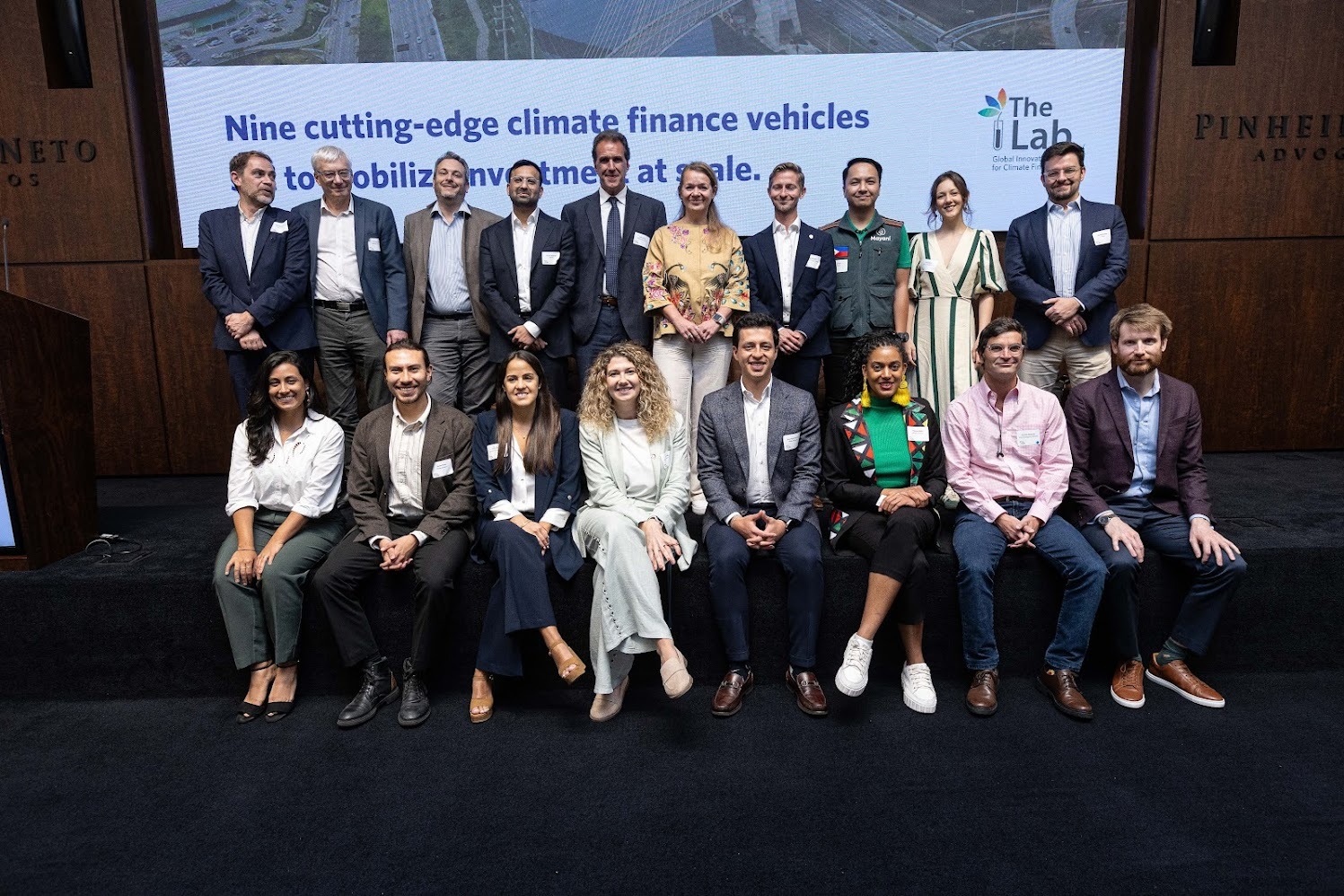

The Global Innovation Lab for Climate Finance has rolled out nine new financial instruments designed to steer more capital toward climate solutions in developing economies.
The cohort, announced last week in São Paulo ahead of the COP30 climate talks, targets some of the most persistent gaps in climate finance: adaptation, nature protection, and energy access.
“No amount of concessional capital substitutes for a good enabling environment,” the Climate Policy Initiative’s Maria Ruiz tells ImpactAlpha.
The instruments are designed with “a greater focus on local capital mobilization—anchoring the thesis in country priorities, real economy needs, and local investor appetite.”
Smallholder finance
Four new instruments span Africa and Asia, targeting gaps from smallholder agriculture to early-stage climate technology.
Philippines-based Mayani is creating a fund that will lend to farmer cooperatives, providing smallholders with affordable loans to adopt climate-resilient practices, along with crop insurance and secured buyers for their produce.
IREN Agri, a partnership between Ksapa and Société Générale, combines medium-term finance, technical assistance, digitalization, and offtake agreements to help farming communities build climate resilience across West Africa.
In India, Green Artha’s Clean Economy Fund uses a blended equity model to back first-of-a-kind demonstration projects that prove commercial viability and attract follow-on investment for novel climate tech solutions.
Scaling solutions in Latin America
Latin America was also prominent
The region “often benefits from deeper local capital markets and lower perceived risk than several peer emerging markets,” says Ruiz.
“We’re seeing an engaged private sector operating within emerging enabling frameworks—taxonomies, disclosure rules—and big opportunity sets across energy and nature-based solutions.”
In Colombia, Strata Advisors is developing a parametric insurance model that finances wildfire response efforts to protect critical water sources.
In Brazil, Silva is pioneering a financial instrument tailored to native seedling nurseries, providing purchase guarantees and long-term contracts to stabilize grower incomes and strengthen reforestation supply chains.
In Argentina and Colombia, Meliquina is developing renewable energy projects with Indigenous communities that include shared decision-making and equity ownership. As ImpactAlpha has reported, the firm is working with the historic Mapuche Millaqueo community to build an 18-megawatt solar project in Argentina’s Patagonia.
“They were proposing that we be partners in a renewable energy project,” said Stella Zapata, a Mapuche leader and key voice in the initiative. “It wasn’t about being employees or beneficiaries—it was about being partners. That was something totally new.”
And the Tropical Resilience Fund, managed by London- and Brazil-based Impact Earth, will provide revenue-based financing, convertible debt, and bridge loans backed by environmental assets to conservation and restoration ventures.
Climate finance
Each proposed instrument selected by the Lab goes through a seven-month program to design, structure, and test its financial model. Afterward, teams can apply to a dedicated pre-seed facility, where about half will receive up to $250,000 in grant financing to move closer to market readiness.
Funders of the lab include Bloomberg Philanthropies, the Government of Canada, Germany’s Federal Ministry for Economic Affairs and Energy, and the United Nations Development Programme, among others.
Global climate finance surpassed $2 trillion in 2024, the highest level ever recorded. Yet much of that capital continues to bypass the regions and solutions that need it most. Only 16% of global climate finance reaches emerging markets outside China, and most of that goes to energy and transport—sectors well understood by institutional investors but far removed from the frontlines of climate risk. Adaptation in emerging markets accounted for less than 4% of total climate finance in 2023.
That is beginning to change, and adaptation is a prominent theme at COP30. “Climate risk integration in financial decision-making is shifting adaptation from ‘nice to have’ to a risk management priority,” says Ruiz.
“Banks and investors are starting to price physical climate risk into lending and investment processes, driven in part by national taxonomies and regulatory guidance.”