
Former SpaceX engineer Tim Balz launched Kalogon five years ago to use artificial intelligence to create smarter seating for wheelchair users. Unexpectedly, he found demand from the US Air Force and commercial airlines and is scaling up to serve pilots and passengers on long-haul flights.
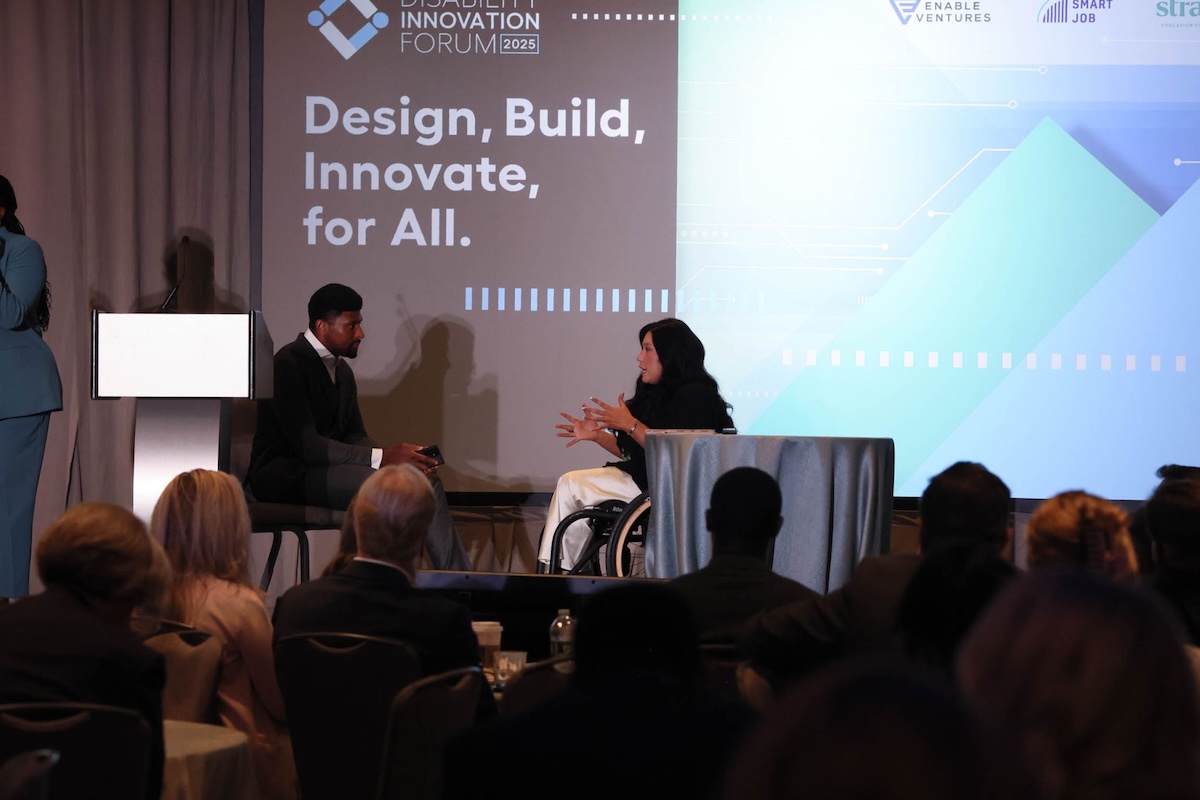
Such “dual-use” solutions were in fashion at the Disability Innovation Forum in Washington DC. Hundreds of founders like Balz are building solutions with and for the disability community that have potential for mainstream market adoption.
Additional revenue streams coupled with a growing disabled population is fueling investor interest in strategies dedicated to disability-focused and -led solutions.
“There’s a $2 trillion hole in the global GDP where disability talent should be,” said Regina Kline of Enable Ventures, which is raising a $75 million fund to invest in tech-enabled tools designed by and for the roughly 1.3 billion people worldwide with disabilities. The impact fund has secured commitments from UnitedHealth Group, the Society for Human Resource Management, or SHRM, and Liberty Mutual Investments, the $100 billion investment arm of Liberty Mutual Insurance.
Kline co-launched Enable three years ago with Jim Sorenson, the billionaire founder of Sorenson Impact, who made his fortune applying video compression technology to real-time captioning to help deaf and hard-of-hearing people communicate more fluidly.
“There are founders with disabilities in every corner of the disability community all over the US who are building right now, and who are looking for capital and support to take their ideas to the marketplace,” said Kline, a disability rights lawyer turned impact investor, during her opening speech (see, “Regina Kline: Closing the disability gap”).
Enable’s portfolio includes Chicago-based DeepWalk, which is using AI and computer vision to inspect and maintain sidewalks and other public infrastructure in compliance with the Americans with Disabilities Act. The fund has also backed New York-based Daivergent for job training for adults living with disabilities and San Francisco based Cionic, which builds wearable tech to improve the mobility of individuals with physical disabilities.
GP snapshot
When Liberty Mutual Investments invested in Enable earlier this year, the investment arm of the major insurance company said it would also co-invest with the impact investor in disability tech solutions.
“The ability to have people who are seeing the world in a different way is something that’s hard to find in markets,” said Ommeed Sathe, who leads Liberty Mutual’s impact and sustainable investments.
Other fund managers are pressing that same advantage. 2Gether-International, a DC-based impact accelerator that supports entrepreneurs with disabilities, is launching a $40 million fund to support high-growth impact startups in 2Gether’s network of nearly 600 disabled founders. “We set out to start a micro $5 million fund, and then got a commitment for a $20 million match,” declared 2Gether’s Diego Mariscal during the event (see, “The impact case for bridging financing gaps for disabled founders”).
Adaptation Ventures, a network of angel investors led by husband and wife Rich and Brittany Palmer, launched earlier this year to invest at least $250,000 in early-stage US startups working to build accessibility technology for people with disabilities.
Samaritan Partners is raising a public benefit venture fund to invest in early-stage disability founders. Chris Maher, who leads the New York–based impact investment firm, is the father of two daughters with physical and developmental disabilities.
K. Ventures, also based in NY, seeks early-stage tech companies focused on serving individuals with intellectual, developmental and learning disabilities.
“There are big capital interests that are looking for impact investments,” Kline said. “There’s a movement towards aligning purpose with capital, not as a trade-off between profit and purpose, but as a total impact alignment.”
Creative economy
The gathering, hosted by Enable Ventures with Strada Education Foundation and SmartJob, convened nearly 300 disability activists and allies across nonprofits, government agencies, financial institutions and film and TV.
“Innovation, to me, means the creation of opportunities that leads to even more opportunities that have never existed previously,” signed producer and film executive Delbert Whetter, translated via a sign language interpreter.
Whetter and his brother, Jevon Whetter, a filmmaker, writer-producer and educator, are the fourth generation of a deaf family in Oregon. As filmmakers, they draw inspiration from their maternal grandmother who often told them stories about watching silent films in theaters during her childhood.
Among the Whetter brothers’ films is “Being Michelle,” an award-winning documentary that follows the journey of a deaf woman with autism who was incarcerated for five years without an interpreter.
“In the entertainment business, we say you have to show what you don’t tell,” Delbert said during a panel discussion moderated by his brother. “With Michelle, you could show the impact of not having any kind of access, and the journey that she experienced and how extreme it was.”