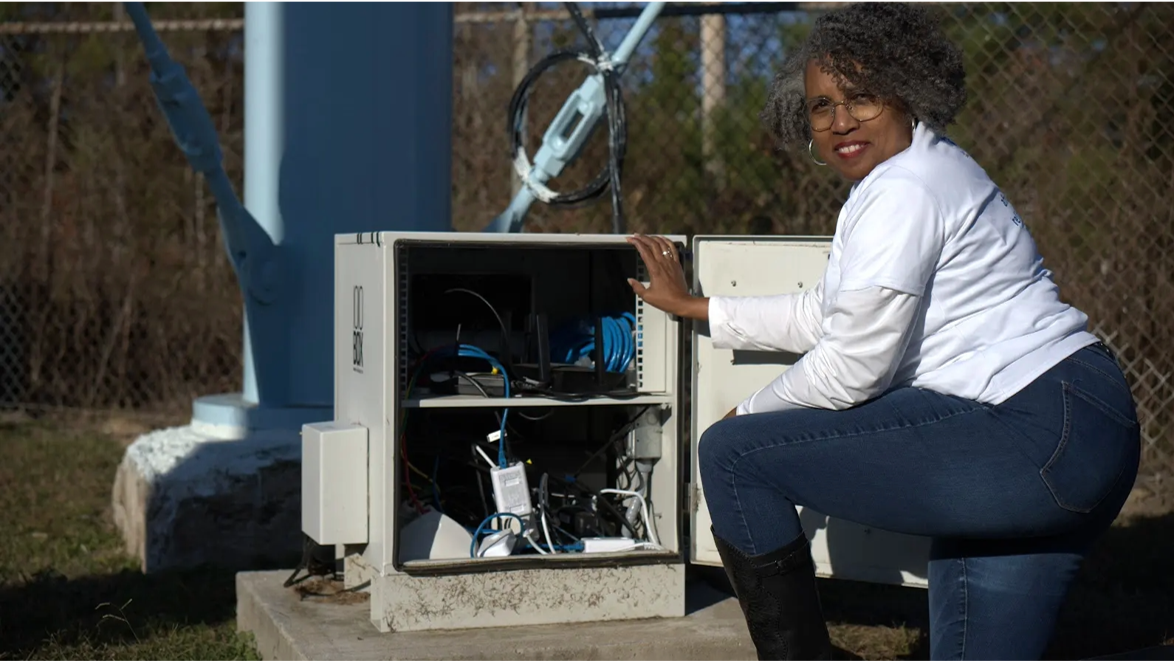

LaShawn Williamson never set out to become a telecoms entrepreneur. Yet when a tornado knocked out internet service in her rural community for two weeks, she and her husband found themselves disconnected from their remote jobs. They took matters into their own hands and started Wave7, a mom and pop internet service provider.
In their community of Enfield, North Carolina, the lack of reliable, affordable connectivity had long held back residents, many of them older, low-income, and isolated. Wave7 has now connected more than 2,000 people at a fraction of the cost of legacy providers.
That Wave7 exists at all is only possible because of a raft of decentralized technology with the power to transform how essential services are deployed in underserved communities. Williamson’s company relies upon Althea, a decentralized internet service protocol that empowers communities to build their own wireless networks where fiber providers have no financial incentive to invest.
LaShawn’s story is not just one of entrepreneurship and community problem-solving. It is evidence of a broader shift in how critical services — from internet access to energy to environmental data — can be financed and deployed. Thanks to new decentralized physical infrastructure networks, or “DePIN,” impact investors have an opening to back models that lower costs, expand access and support shared prosperity.
As digital assets enter the mainstream and stablecoin legislation creates momentum and legitimacy for adjacent digital asset innovations like DePIN, it is critical for investors to look beyond financial use cases.
The insights in this article come directly from the Crypto Council for Innovation’s recent research in partnership with the W.K. Kellogg Foundation. Our forthcoming report on the ascendance of DePIN documents how these models are lowering costs, expanding access, and fostering new forms of community ownership in internet connectivity, geospatial sensor networks, and energy grid management.
A new model for critical services
Traditional infrastructure networks like broadband and energy grids are centralized and costly. A single provider typically finances and operates everything — from cables and cell towers to data centers — leaving many rural and low-income areas underserved or facing unaffordable bills. The FCC estimates that 24 million Americans still lack fixed broadband. Cost is a significant barrier; even in cities like New York, a third of residents lack affordable high-speed internet.
DePIN flips this model. Instead of one company bearing all costs, blockchain tools like smart contracts and utility tokens coordinate many contributors. Individuals or small businesses invest in hardware — like antennas, dishes and sensors — and are automatically compensated for the resources they provide. For ISPs, this translates to community-operated wireless networks built at a fraction of the cost of fiber. Customers benefit from affordable, pay-as-you-go services, while investors gain models that deliver measurable outcomes in access, affordability, and community ownership.
Transforming broadband, insurance and energy
DePIN networks are already operating at scale in a range of sectors, lowering barriers to access while creating new micro-entrepreneurship opportunities.
For example, Althea powers community ISPs serving hundreds of thousands of customers in North Carolina, Arizona, Alaska, and rural California. Bills average about $40 a month — well below the national average of $60-$90 — with transparent pricing that lets customers pay only for the data they use. I’ve seen the impact firsthand in rural North Carolina and Arizona, where households, small businesses, health providers, and veteran housing communities are gaining affordable connectivity.
Similar DePIN models empower wider access to critical data for communities and small businesses. Through decentralized sensor and Internet of Things networks, individuals deploy hundreds or thousands of sensors and receive compensation for real-time data on geospatial location, climate conditions, air quality, road conditions and more.
The decentralized geospatial data network Geodnet launched in 2022 and now operates more than 11,000 sensors globally, more than twice the number of sensors of either of its closest traditional competitors. WeatherXM has deployed more than 7,000 weather stations, providing hyperlocal data. These sensors could prove particularly valuable in the face of cuts to weather forecasting and climate data collection.
With lower costs and faster deployment, DePIN sensor networks broaden affordable data access and help close equity gaps. For example, farmers in regions with poor geospatial or climate data face higher insurance costs because risk cannot be properly assessed. The global insurance company Lemonade has piloted on-chain parametric climate insurance for smallholder farmers in East Africa and is exploring ways to leverage DePIN networks to expand coverage.
Decentralized sensor networks can also support more responsive local infrastructure and planning, better informing local governments around issues ranging from traffic patterns to catastrophic climate risks. For example, Mercy Corps Ventures is piloting solutions to help trigger early flood warnings and anticipatory aid payments in Nepal that help affected people recover faster, using decentralized payment rails. Integrating expanded decentralized sensor networks could expand access at scale.
Energy companies are also deploying DePIN hardware add-ons to make grids more efficient and resilient. Fuse Energy and Via, for example, use blockchain to track real-time usage, rewarding customers with tokens for shifting energy demand to off-peak hours or periods of high renewable supply. These tokens are redeemable for lower rates, electrification upgrades or bill credits, effectively lowering costs while making regional grids more resilient.
The value proposition for investors
For impact investors, DePIN offers four distinct value propositions:
- Reduced CapEx requirements: By decentralizing infrastructure ownership, DePIN minimizes the upfront costs required to expand services, making scarce investment capital more efficient. This means that community operated networks can recoup capital investments in a much shorter timespan than traditional centralized operators, while still providing lower-cost services.
- Affordability for end users: DePIN makes new business models possible. Lower deployment costs translate into more affordable services, such as internet connectivity or access to critical business data for farmers and small businesses.
- Resilience and redundancy: Unlike centralized systems vulnerable to outages or supply chain shocks, DePIN creates networks with no single point of failure. By helping to manage energy grid demand and tracking real-time environmental conditions, they help communities address climate risks – from reducing peak energy usage to monitoring weather conditions in flood-prone communities.
- Local economic participation: Community members can become stakeholders and earn income by contributing to a decentralized network, creating new pathways for inclusive economic development. While the level of income can vary for node operators, we observed that even minimal amounts of new passive income helped operators build economic resilience.
As detailed in our forthcoming report, we met homeowners and small business owners making extra money by deploying an internet connectivity, 5G wireless, or internet of things node on top of their homes or businesses; home battery owners making money by selectively selling power back to the grid at peak hours; home weather station operators making money selling weather data to companies that use it in myriad ways; and drivers making money simply by adding dash cameras to their car.
Opportunities ahead
The characteristics described above suggest that DePIN is well suited for blended finance. Philanthropic first-loss capital or concessional loans can de-risk early deployments, while private investors can enter once networks demonstrate revenue traction. This is the definition of catalytic capital: impact-first money crowding in private capital to achieve both impact and financial returns.
DePIN represents the next frontier for impact investors: a chance to fund models that not only close access gaps, but create affordable and resilient systems that communities themselves can sustain.
Renee Pinto da Silva Barton is the manager for impact research at the Crypto Council for Innovation.