
Greetings Agents of Impact!
Our monthly newsletter, ImpactAlpha Latin America, drops today. Opt-in to receive ImpactAlpha Latin America as part of your subscription.
🔌 PluggedIn: Building inclusive markets for clean energy with Harrison Wallace. Community power creates the conditions for inclusive clean energy markets. On the next PluggedIn, host Sherrell Dorsey will speak with Harrison Wallace of the Climate and Clean Energy Equity Fund to discuss why equity metrics matter as much as emissions reductions in climate investing. Plug in Tuesday, Sept. 2 at 10am PT / 1pm ET / 6pm London. RSVP now.
In today’s Brief:
- Meet SAFI, the newest tool in impact-linked finance
- $200 million for distributed solar infrastructure
- EWA Capital’s gender-smart fundraising milestone
- Giant Leap’s impact startup benchmark
Featured: Innovative Finance
Forget SAFEs. Impact investors are incentivizing growth and impact with SAFIs. An experimental idea by the impact finance experts at Roots of Impact is ready for prime time. The German advisory firm is out with a twist on the simple agreement for future equity, or SAFE, that aims to help founders and their investors align on impact ambitions. The “simple agreement for future impact,” or SAFI, enables entrepreneurs to raise early funding tied to their impact objectives without immediately setting impact targets. The flexible funding mechanism is the latest addition to a suite of products Roots of Impact is championing to build the field of impact-linked financing. The Roots team can vouch for the model because they first tried it for their own fundraise. “Our investors asked us, ‘How should we structure this round? It should help you achieve the impact you want, and you are the experts’,” recalls Roots of Impact founder Bjoern Struewer. The first SAFI was finalized last year when Roots of Impact closed its investment round with Delta Fund, the European Social Innovation and Impact Fund, BMH and the Swiss Agency for Development and Cooperation.
- Early roots. Struewer started Roots in 2015 with a mission of making entrepreneur-friendly financing more prominent and rewarding to founders with social impact goals. The company’s earliest and most widely known product, social impact incentives, or SIINCs, was designed to offer bonus payments to companies as they achieved specified impact milestones. The mechanism has been used dozens of times, including to incentivize diabetes care for low-income patients in Mexico, small farmer financing in Colombia, rural dentistry in Ecuador and more. Roots has also designed impact-linked loans and incentives for entrepreneurs to set up impact management and measurement systems. The company’s broader vision is to see impact incentives baked into every type of financing structure. “You can link finance to impact in all instruments,” says Struewer. “This is not a product, it’s an approach.”
- IOU for impact. The SAFI is a new spin on revenue-based financing – a flexible debt instrument that allows companies to repay their investors based on how much they earn rather than in fixed installments. The SAFI assumes that new companies need flexibility in figuring out how to achieve the impact they aim to achieve. When an investor and entrepreneur sign a SAFI contract, they establish financing terms that reward the entrepreneur with a repayment discount for reaching their impact goals. But those goals don’t have to be set immediately. It’s modeled on the SAFE, which allows a very early-stage company to raise equity without an immediate valuation. “The SAFE is a templatized version of an IOU on a napkin. SAFI’s innovation is that you agree to agree on the impact later on,” explains Aunnie Patton-Power of the Innovative Finance Initiative, which supported Roots of Impact in workshopping SAFI’s design.
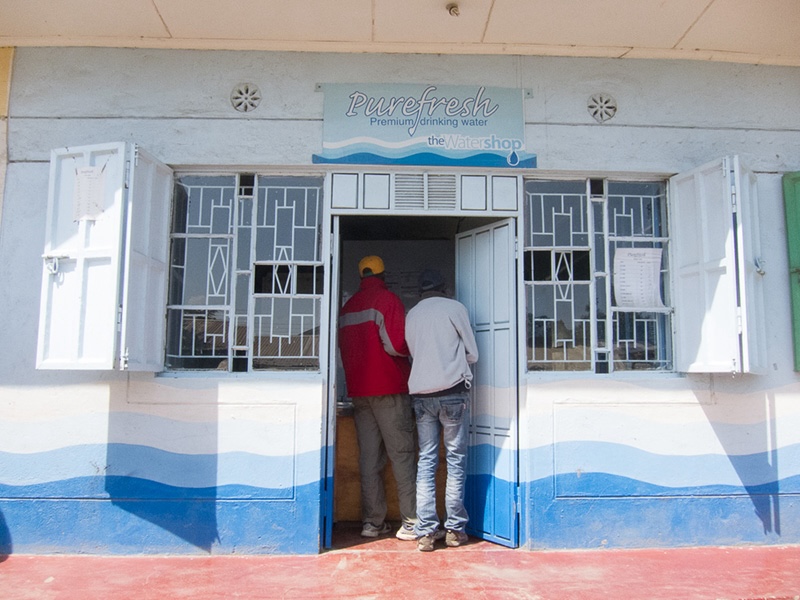
- Market infrastructure. The SAFI wasn’t a crystallized concept when Roots of Impact started fundraising. Investors drawn to the company’s mission saw an opportunity to do more than fund its work; they could be a proof point. “Because our round was all about building the market infrastructure for impact-linked finance, we consequently agreed that as an outcome, we are creating our competition,” explains Struewer. “That is metric number one: volume and traction of impact-linked finance deals implemented by all practitioners.” Roots of Impact has also piloted the SAFI with Purefresh, a Kenyan water distribution company that secured financing from impact investor Aqua for All to expand its network of affordable water kiosks. Struewer says the SAFI was designed simply so it could be adapted to any type of business in any context. “We were known as the SIINC company,” he says. “Three years from now I assume we’ll be known as the SAFI company.”
- Keep reading, “Forget SAFEs. Impact investors are incentivizing growth and impact with SAFIs,” by Jessica Pothering and Erik Stein.
Sponsored by Tideline
Scaling Solutions: The impact fixed-income opportunity hiding in plain sight (webinar). Impact investing has largely focused on the private markets. To meet today’s most urgent social and environmental challenges, the impact investing market must unlock the potential of an investor’s full portfolio, including in fixed income, the largest asset class globally. A new report from Tideline, BlueMark, and Builders Vision makes the case that fixed-income strategies can mobilize impact capital at scale. Impact investing in fixed-income, or “impact fixed-income,” argue the authors, is a capable and accessible strategy to deliver measurable outcomes alongside financial performance.
- Join the call. In this Compass Series webinar, the report’s authors will be joined by impact fixed-income managers featured in the report, including Edentree, Nuveen, T.Rowe and Wellington. Learn about unlocking what’s possible when institutional discipline is applied to urgent social and environmental challenges. The discussion will be grounded in Scaling Solutions’ key insights – bridging the gap between intention and execution in impact investing. RSVP for the conversation, taking place Monday, Sept. 8 at 9am PT / 12pm ET.
Dealflow: Green Infrastructure
GDEV Management pulls in $200 million for a second distributed solar infrastructure fund. It’s a tough time to raise money for a renewable energy infrastructure fund, given the political headwinds. GDEV’s focus on small and mid-sized on-site solar and storage projects, which have largely escaped broader attacks on renewable energy, have given it something of a “policy proof” edge, says the firm’s Benjamin Baker. “I think we’re going to see the industry focus on distributed energy resources, which positions us very well,” he told ImpactAlpha. A phase-out of tax credits by the end of 2027 could spur a build up of more facilities ahead of time, he predicts. GDEV, launched in 2020 by Greenbacker Capital, closed its second fund with support from US insurance funds and the pension fund of Ontario Power Generation, a returning investor.
- Scaling development. GDEV invests in early-stage developers of solar and battery storage and helps them scale. It brings in partners once its developers have large capital needs. For example, when hydropower developer Relevate Power acquired Gravity Renewables, GDEV turned to Apollo Global to finance the deal. GDEV invested in battery energy storage developer Lightship Energy (formerly Delorean Power) in 2021, and helped the company raise more than $100 million from other investors two years later. “We’ve been creative in scaling businesses despite having a small fund,” said Baker. THe second fund has already invested in Nexus PMG, an infrastructure advisory and engineering firm; Lightshift Energy, a utility-scale energy storage developer; and EV charging company 3V Infrastructure. GDEV’s first fund raised $140 million in 2022 and invested in ten on-site or “behind the meter” developers.
- More.
EWA Capital raises a $24 million gender-smart venture fund for Latin America. Early-stage venture capital in Latin America remains a tough sell for women-led funds. Bogotá-based EWA Capital has made the case: its second fund, EWA II, closed at $24.4 million, above its $20 million target, with backing from nearly 50 investors. EWA backs startups in fintech, enterprise software, health, education and clean energy. The firm looks for companies with female founders, executives, board members, with majority-women customers, or with strong gender goals. “When we started in 2019 there were less than 10 female fund managers in Latin America. Instead of seeing that as a weakness, I said: this is our differentiation – let’s do things differently,” EWA’s Patricia Saenz told ImpactAlpha (see “In Latin America, investors see economic opportunities through a gender lens”).
- 360-degree approach. EWA’s gender-lens approach extends beyond its portfolio: it aims to cultivate a new generation of female investors across Latin America. More than 40% of investors in EWA II are women, many of them wealthy individuals or women-led family offices investing in a private fund for the first time. EWA set a $50,000 minimum commitment to lower barriers for investors and tapped into growing investor interest in gender equity. EWA II also drew backing from COFIDE and Bancóldex, the International Finance Corp., Visa Foundation, the Women Entrepreneurs Finance Initiative, and Mexico’s government-backed Fondo de Fondos. Sonen Capital and Switzerland’s Mountain Partners also participated.
- More.
Dealflow overflow. Investment news crossing our desks:
- Dutch development finance institution FMO approved a $10 million investment in Lendable’s second MSME Fintech Credit Fund to finance fintech companies in Africa, Asia and Latin America. (FMO)
- Danish private equity firm Maj Invest and Novo Holdings led a $47.5 million Series E equity round for MedGenome to expand access to genomics research and diagnostics in India and other emerging markets. (Novo Holdings)
- Swiss impact asset manager responsAbility provided €27.5 million ($32 million) for Turkiye’s DenizBank Group to support its small business lending and green leasing services. (responsAbility)
- RSF Social Investment Fund closed the first offering of its CUSIP-assigned broker notes, with gross proceeds of $5.4 million (see “‘Broker notes’ expand access to RSF’s Social Investment Fund”). RSF also loaned $4.2 million from its Social Investment Fund to BlocPower, Solaris and Plankton Energy.
Agents of Impact: Follow the Talent
Parrish Pepestem, previously with Boston Consulting Group, joins Raven Indigenous Capital Partners as an investment analyst… Ownership Works welcomes Angela Duffy, previously with UNICEF USA, as senior director of marketing and communications.
Symbiotics is looking for an investment intern in India… IIX seeks a senior vice president of capital syndication and innovative finance in Bangladesh… Chan Zuckerberg Initiative is hiring legal counsel for investments in California… Stanford University has an opening for an associate director for its GBS Impact Fund program.
Maycomb Capital is on the hunt for an investment associate in Brooklyn… Big Valley GmbH is looking for legal counsel for its impact fund for waste management solutions in food systems… Giant Leap will host a webinar to share key insights from its “Impact Startup Benchmark” report, Monday, Sep. 1.
👉 View (or post) impact investing jobs on ImpactAlpha’s Career Hub.
Thank you for your impact!
– Aug. 27, 2025