
In case you missed it, Congress and the President passed a big bill back on July 4th.
The “One Big Beautiful Bill,” or OBBB, was a distressing piece of legislation for those in the climate world.
It put a lot of Biden’s signature climate bill, the Inflation Reduction Act, into the shredder, including some of the main sweeteners for climate action like the:
- EV Tax Credits: Now expiring Sept 30, 2025
- Home Solar/Battery Credits: Now expiring Sept 30, 2025
- Utility Scale Solar/Wind Tax Credits
(P.S., if you’ve been meaning to get an EV, solar system, or battery you only have two months left to get the tax credit).
The bill dealt a serious blow to America’s progress on decarbonization and emissions reductions. But in this piece, we wanted to focus on the other end of the spectrum. What, if any, silver linings could come for climate solutions from the OBBB?
The OBBB gut punch – and the climate community’s response
The inspiration for this article has been the conversations we’ve been seeing in the climate community itself.
There has been a lot of anger and grief. But there’s also been a marked amount of… something like gumption.
Because the reality is after something close to a worst-case scenario sets in, you’ve established a floor. It’s unlikely to get much worse than this, politically.
When the rules of the game change, it doesn’t mean you forfeit, you just have to change strategy.
Because even with the OBBB, climate solutions, particularly solar and batteries, have a lot going in their favor:
- Electricity prices are spiking across the US in response to sharply rising demand, particularly from AI data centers.
- The backlog for natural gas turbines in the US is now over 7 years.
Even without tax incentives, solar and batteries are likely going to be the cheapest and fastest way to deploy new electricity for a long time. And the more of them we manufacture, the cheaper they tend to get.
Here are three potential scenarios where we could see real silver linings for climate solutions from the OBBB. We had some fun and gave them catchy names:
- Residential solar, reborn
- Store now, generate later
- States ❤️ affordable energy
Scenario 1: Residential solar, reborn
While there are the climate nerds out there (like me) who want to be generating carbon-free electricity, the driving reason for most people to adopt solar is economic. A few trends may point to increased adoption in the future:
First, utility electricity prices are rising sharply, so more homeowners will likely be open to paying for alternatives to lock in some price savings and protection.
Second, to survive without a giant contraction, the residential solar industry will need to innovate — fast. They need to find creative ways to cut costs where they can so they can bring down the overall cost of a system. We’re already seeing that start.
Third, we don’t know how states and municipalities will react to rising electricity prices. (Much more on this below).
Perhaps the OBBB is what the residential solar industry actually needed to not just survive, but thrive. Perhaps it is the jolt the industry needed to produce an offering that was universally economically attractive, regardless of what happened in Washington.
Maybe that means slashing costs to make the overall systems more affordable. Ravi Mikkelson at Atmos Financial has written about how much of the cost of a solar system is soft costs in marketing, permitting and lending costs.
Maybe it’s integrating Virtual Power Plants to make it more profitable to sell power back to the grid at peak hours.
Maybe it’s states pushing utilities to approve adding residential solar systems instantly if they don’t rely on selling power back to the grid. Given the sharply rising electricity prices here in the US, a solar battery system could very well pay for itself without needing to sell any electricity back to the grid.
Or maybe it’s even more innovative models like solar panels that just plug directly into a wall socket, as our friends at BrightSaver are doing here in the Bay Area.
Could the OBBB and the pullback of tax credits that the residential solar industry got overly dependent on be the painful wakeup call the industry needed to reach its next stage of evolution?
Could the OBBB Make American Solar Great Again?
It’s less crazy than it sounds.
Scenario 2: Store now, generate later
Our second silver lining scenario is all about batteries.
The utility-scale tax credits for solar and wind energy are getting axed.
While the tax credits from the Inflation Reduction Act will live on for other forms of zero-carbon electricity generation like geothermal, hydro, and nuclear, each faces barriers to rapid scale-up over the next 5 years (immature tech, capital-intensive, long to deploy, etc.)
But do you know what is ready for prime time and still has a great tax credit? Utility-scale batteries.
Batteries do not generate their own electricity (obviously).
Instead, they store electricity from when it is produced to when it is needed, which makes them a great pair with solar or wind.
We’ve already been seeing a lot of battery deployment in the US:

The big question for batteries is what will happen to their rate of adoption after the solar and wind tax credits go away.
Will their adoption drop as they really do pair best with intermittent electricity sources?
Or will developers and utilities keep approving them to soak up any available unused electrons from existing wind and solar already built?
Back when we started Carbon Collective, we read a bunch of books on climate change and the energy transition. One covered solar in depth and argued that most electricity systems hit a local maximum of solar deployment. Once you have something like 30% of your electricity coming from the sun, the value of adding new panels starts to cancel out because there’s just not demand for more electricity when the sun is shining.
Batteries have long been promised as the way to bridge this gap, helping the economics of utility-scale solar stay in the black.
But maybe we’ll see a reverse. Rather than solar holding the door open for batteries to come onto the grid, maybe we’ll see batteries do the same for solar. Because it’s not like utility-scale solar was outlawed. It just lost a big tax credit. And electricity prices are rising faster than they have in a long time.
The battery tax credit will remain in place until 2033, after which it will start to phase down. That’s a long time with a big tax incentive for a mature technology to be deployed.
So, who knows. Maybe 2025 – 2035 will be the era of the battery.
Scenario 3: States ❤️ affordable energy
Rising electricity prices are already making headlines. Here are a few from late July:
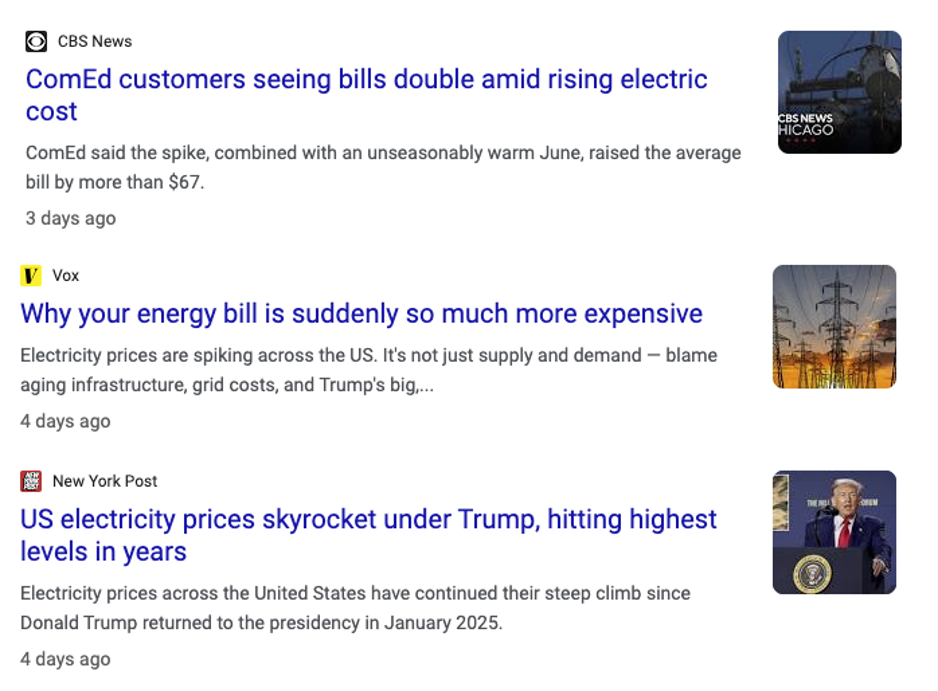
And this is before the impact of the OBBB is really at all felt.
The energy system modeler Zeke Hausfather published a fascinating and vindicating report a few weeks back looking at the relationship between the deployment of renewable energy and average electricity prices over the past 24 years in the US. What he found fit what many renewables advocates had been saying. Renewable energy can drive down overall energy costs in diversified electricity grids.
One of the biggest lessons of the 2024 election cycle around the world was that people really don’t like inflation. They don’t like living with the sense that prices for key goods like food or electricity are going up.
So, with electricity prices rising and local populations unhappy, how will politicians respond?
In the US, the States are sometimes called the “Laboratory of Democracy.” There’s 50 of them, and they try different ways to address problems. Some things work, and some don’t.
It is going to be fascinating to see how states respond to the OBBB.
Will a state like California pass its own subsidies for renewables?
Will a state like Nebraska cut red tape for new wind energy?
Will Nevada embrace being the solar hub of the country and seek to export its sunny skies?
Nobody can know what the specific reactions will be, but we can be confident that there will be reactions. And some of them could have quite an impact.
The OBBB introduced a notable gap in the energy system. But that gap will not stay empty forever. It will only be a matter of time until other political energy fills it. And who knows what innovative policies and ideas it could unlock.
Competing forces
We’ll end with this from Zeke’s report:
“The end of the investment tax credit (ITC) and production tax credit (PTC) for wind and solar with the passage of the so-called “one big beautiful bill” (OBBB) are expected to increase the costs of renewables projects by 30% to 50%. This will likely significantly reduce the rate of non-hydro renewable expansion in the near term, leading to higher electricity prices for ratepayers in many states.
“At the same time, the costs of renewables have continued to fall at a remarkable pace. Utility scale solar generation is around 66% cheaper today than it was a decade ago, and wind is around 33% cheaper, excluding the effects of any changes in tax credits.”
In April, if you had asked the average person on Wall Street what odds they would give to Carbon Collective’s Climate Solutions ETF outperforming the S&P 500, they’d probably say close to 0.
But it’s happened.
The OBBB will likely be a net negative for climate and for climate solutions.
And it might not be.
The world is a complex machine of interacting, balancing forces.
So let us hope there are even more silver linings than we outlined here.
Zach Stein and James Regulinski are the co-founders of Carbon Collective. ImpactAlpha has partnered with Carbon Collective to provide a monthly analysis on how individuals, companies, and organizations can incorporate the realities of our changing climate and energy systems into their investments. The analysis originally appears in Carbon Collective’s newsletter. All content is solely for informational purposes and should not be used as the basis for investment decisions.