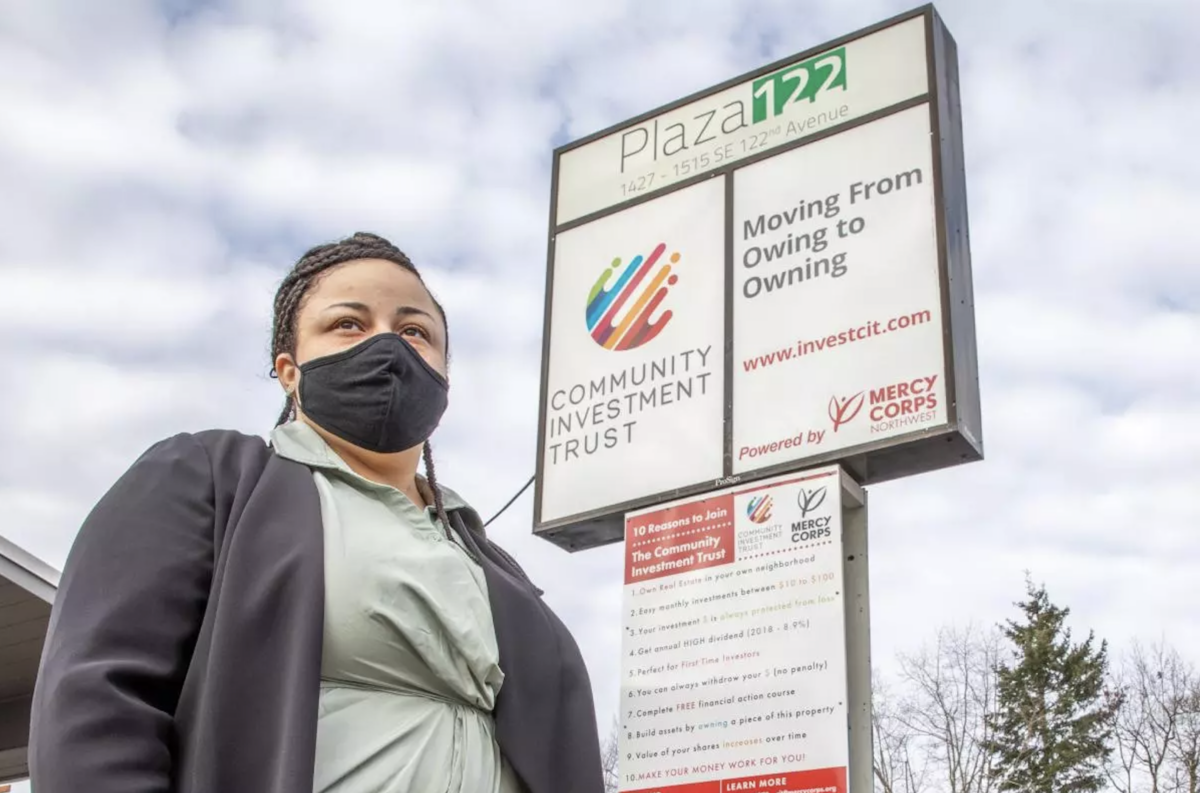

Nearly 350 lower-middle-class residents in southeast Portland have a small slice of the upside appreciation of Plaza 122.
The well-kept strip mall in the city’s Centennial neighborhood houses a Latina-owned hair salon, a Somali community organization, an African holistic health nonprofit, an Ethiopian and Eritrean cultural resource center, a food cart and a taxi cab company.
The single-story, 29,000-square-foot commercial property is owned and governed by the residents under a Community Investment Trust, or CIT. Since 2017, 345 families have drawn money from their incomes and savings to invest $767,000 into buying shares of the property. Portland’s east side has a vibrant and diverse immigrant population, including refugees from east Africa, eastern Europe and the Middle East.
The mall, one and a half acres at 122nd and Market Street, was bought in 2017 for $1.2 million. Today it is valued at nearly $2.2 million, giving the owners a paper gain of nearly $1 million over seven years. But it’s not all paper: 122 families have cashed out their stakes for a total of $310,000, for a total wealth gain of $147,000.
Two years ago, Mohammad Khalid, a 27-year-old neighborhood resident who immigrated from Iraq, cashed out his stake in the community investment trust to open a traditional Iraqi bakery with his cousins. He had been investing $50 a month in the community investment trust since 2020.
“I wanted to start my own business and I needed [a] down payment for my business,” Khalid told ImpactAlpha. “I was like, ‘Okay, I have a good amount of money in the CIT, so why not cash out for now to be able to start my business?”
Khalid says the trust has brought the East Portland neighborhood together. “You’re investing in your community and you’re investing in small businesses. And they themselves invest in you, because when they are doing good you are doing good as well.”
Mercy Corps Northwest, a nonprofit community development financial institution and local affiliate of the Portland-based non-governmental and humanitarian aid group Mercy Corps, bought the strip mall in 2017. Residents, who can buy into Community Investment Trust for as little as $10 a month, now own roughly 36% of the property and receive a dividend. The trust paid out dividends of $26,000 in 2023.
Such community trusts are gaining popularity as a way to cut long-term residents into appreciating property values, making them not only victims, but beneficiaries of rising real estate prices. The community ownership model has been touted as an effective anti-gentrification and displacement strategy in fast-gentrifying neighborhoods by giving locals power and ownership of commercial assets.
“We really want to connect with neighborhoods to see the power of generating wealth locally, in a way that’s not extractive,” said Mercy Corps’ John Haines.
“We didn’t project to do this well on income and share price change, [but] people are making a great return on their investment and it’s risk free,” he says. “So, it’s kind of wild, but it’s working.”
Loss protection
Haines and Mercy Corps are taking the Community Investment Trust model to other US cities this year, starting with Omaha, Albany, Tulsa and Dallas. Another dozen cities are lining up. Haines is spinning-out CIT Services from Mercy Corps to work with nonprofit leaders who are trusted in their communities to set up the place-based community investment trusts.
“The East Portland Community Investment Trust is a great example of what people want and we want to create a real network.”
Hanes led the incubation of the Community Investment Trust model after surveying local East Portland residents in neighborhoods that struggled with access to economic mobility. The East Portland Community Investment Trust was formed shortly after to acquire and rehabilitate Plaza 122.
“We really started by looking at where poverty resides, which was quite literally with renters by and large,” Haines, a Portland resident, told ImpactAlpha. In East Portland’s highest-poverty census tracts, he says, “the big bubble of our renters are the working poor, people of color, single parents, refugees and immigrants, people coming out of incarceration and a range of other difficult circumstances.”
To bring in community investors into the East Portland CIT, Haines split the $450,000 down payment into a $450,000 stock offering that allowed residents to invest as little as $10 for a single share and up to $100 for 10 shares on a monthly basis.
Haines says he and his team at Mercy Corps took a behavioral economics and human-centered approach to connect directly with residents. In the surveys, “they said: we have limited dollars to invest, we don’t understand investing, we’re risk-adverse.” He added, “when I heard ‘that’s for other people,’ it just catalyzed, okay, we’re gonna do this.”
East Portland CIT’s community investors invest $80 per month on average in the trust and 70% invest the maximum amount of $100 per month rate. Before they can invest, they must complete a six-hour financial literacy course, called “Move from Owing to Owning,” which is offered in five languages thanks to financial support from Portland’s Meyer Memorial Trust and JPMorgan Chase.
The trust offers residents loss protection and the ability to exit their investments at any time. The share price goes up as Plaza 122’s value increases, but should the commercial property’s value plummet, the community investors are protected under a “direct pay letter of credit” from PA-based Northwest Bank.
East Portland CIT received pro-bono legal assistance from global law firm Orrick, Herington & Sutcliffe to set up the direct pay letter of credit structure, which secures the value of the community investors’ principal and ensures they can withdraw funds at any time. The financial tool is backed through an exemption clause under the Securities Act of 1933, which allows federally-chartered banks to issue certain securities without having to register them with Securities and Exchange Commission, enabling them to sell their debt securities more easily to the public.
East Portland CIT’s direct pay of letter credit is “structured as a credit-backed structure that stays in place should the corporation collapse or close,” Haines says. “All the investors are assured that it’ll draw on the direct payload of credit if we don’t have liquidity ourselves. It always protects investors from loss anytime, and people can cash out anytime they want for whatever reason.”
Community ownership
A growing set of community ownership models are helping residents build wealth in commercial real estate assets typically accessible only to wealthy individuals and accredited investors through private equity real estate funds and Real Estate Investment Trusts, or REITs.
Trust-based community ownership models, including community land trusts, mixed-income neighborhood trusts and community investment trusts, are leveraging underutilized legal structures and low-cost debt and grants as catalytic capital to place ownership and governance of neighborhood commercial assets in the hands of local residents.
By pooling resources as a neighborhood to amplify their buying power, they’re lowering the cost of entry into the commercial real estate market to ride up rising property values.
When successful, these community ownership initiatives can create meaningful payouts and value for local residents. When they fail, hard-working families and communities suffer. Complex governance structures can be tricky and collective ownership means some participating community investors won’t get the experience of property management.
In California’s low-income and communities of color, San Francisco-based Community Vision is looking to deploy between $40 million and $50 million in low-cost debt capital this year in community land trusts and other community ownership initiatives to purchase and develop real estate.
“Real estate ownership is an anti-gentrification tool that builds power in communities — both political power and financial power,” says Community Vision’s Catherine Howard (see, “Community Vision’s ownership strategy for combating displacement of small businesses and nonprofits in California”).
With its Mixed-Income Neighborhood Trust model, Trust Neighborhoods formed a partnership with the East Boston Community Development Corp. and Boston Impact Impact Initiative to acquire, rehabilitate and preserve a $47 million portfolio of 36 multifamily properties as affordable housing for local residents. The Kansas City-based nonprofit is looking to expand the model with community-focused actors in about a dozen US cities.
In Chicago and Baltimore, Lyneir Richardson’s TREND Real Estate Fund is co-investing with local residents in neighborhood shopping centers, through community investment vehicles, or CIVs. TREND has set the cost to invest at $1,000, but local residents have invested an average $2,000 to buy in.
And on Kansas City’s east side, Local Code is buying back a block of affordable and workforce housing, transit-oriented retail, health and wellness centers, to be placed in the hands of local residents. Local residents can invest as little as $100 per month in the projects through a direct public offering, or DPO.
Collaborative effort
Haines wants to create a fund that would provide equity capital to the locally-based community investment trusts to make the down payment on a commercial property. Through feasibility studies and advising with the local partners, he estimates each replication site will need $2 to $5 million to set up a trust and acquire a building, through a blended capital stack that leverages low-cost catalytic debt and impact investment equity.
“We have a really interesting network and they’re all struggling with the capital to buy a property,” Haines says. Finding the sweet spot between affordable capital for communities and attractive returns for investors is a challenge, he adds, but aggregating deals could allow community trusts to offer larger deal sizes that could be more attractive to impact investors.
“The best buildings are like the one we bought in East Portland, a kind of overlooked 1962 building that needed a little attention,” says Haines. “Commercial buildings that can attract the kind of businesses and service providers that a neighborhood wants.”
Launching the East Portland Community Investment Trust was a collaborative effort, supported by all kinds of partners ranging from law firms, individual investors, community development financial institutions, or CDFIs, and banks. Mercy Corps Northwest withdrew $220,000 from its own balance sheet, combined with $230,000 of subordinated debt from two individual impact investors, to make the $450,000 down payment on Plaza 122.
Beneficial State Bank, the Oakland-based community bank and CDFI founded in 2007 by billionaire politician and climate investor Tom Steyer and his wife Kat Taylor, provided $900,000 in loans to cover the mortgage in the $1.2 million sale. The rest of the capital was used for the repositioning of the property, which was 66% leased at the time, to attract new tenants.
More than half of Plaza 122’s owners are low-income renters and first-time investors in commercial real estate, and the majority are women and people of color, who pay as little as $20.21 (current share price) a month to purchase a share of the property.
The 345 families invested in the East Portland Community Investment Trust have felt a deep sense of belonging in their neighborhoods since becoming part owners in the local strip mall. Some have used their dividends and payouts to become homeowners and business owners. A majority of residents who have previously exited have later re-invested in the trust.
Sarah Berkemeier, a 44-year-old native Portlander and mother of two, was able to put up her shares in Plaza 122 as collateral to purchase the home where she and her 12-year-old and six-year-old had been living in for more than nine years.
“The owners gave us notice that they were planning to sell it in summer of 2024, and so we really have a scramble to get ready because we weren’t ready to buy our home,” Berkemeier says. “I had to show every kind of penny I could have in order to make a loan application that was successful.”
The trust surveys investors each year when they re-subscribe at the new share price. “We ask them questions like: Do you vote? Do you do volunteer work? Do you visit the building and have your relationships grown because of your investment?” Haines says. “And people report that this greater sense of belonging is profound and meaningful to mix the community together.”
The property is 88% full and Haines said retaining tenants has been the easiest part of managing the property. Some of the tenants themselves are participating community investors.
“We cleaned up a property that was underperforming, stabilized rents, and did the deferred maintenance,” he says. “All of a sudden people went, ‘Wow, we’d love to rent space there.”