
Overlooked founders that target underserved consumers and face ingrained biases that hamper their access to capital. Sounds like the basis for an impact investing fund.
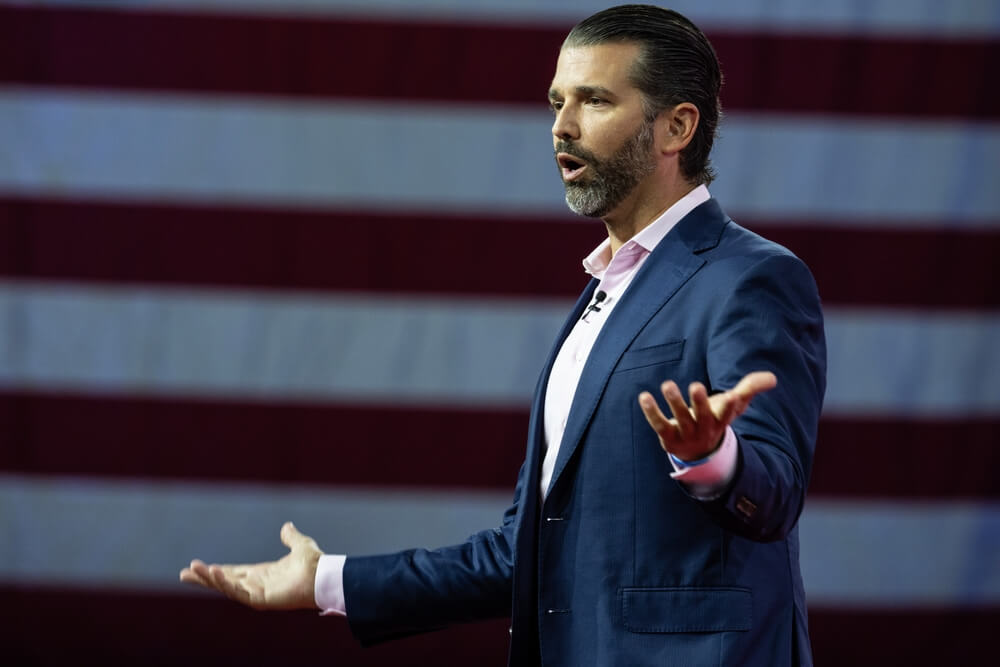
That’s apparently what Donald Trump Jr. thought in announcing that he had passed on a role in his father’s incoming administration to join up with the venture capital firm, 1789 Capital.
In form, at least, 1789 Capital’s investment thesis looks like other social justice investing strategies. The underserved market? Conservative-leaning customers. The overlooked founders? Entrepreneurs seeking to reach them, according to the Palm Beach, Florida-based firm.
Investors “typically don’t want to be affiliated with conservative companies,” 1789 founder Omeed Malik told The Wall Street Journal last year. Generally, after a rich, ideological benefactor helps launch a conservative company, he said, “There is no institutional support to continue to finance that business.”
Such unjust bias on Wall Street and in Silicon Valley excludes businesses serving those customers from raising capital, they claim. Filling that capital gap, the firm is betting, is an opportunity to “build American prosperity” and generate outsized returns. Impact alpha, they might call it.
Donald Trump Sr. rode back to the Oval Office on an anti-woke message, espousing the virtues of merit over “woke” efforts to address injustice. Don Jr. has declared “woke is dead.”
So, far be it for ImpactAlpha to call the strategy ‘woke,’ but no less an authority than Florida Gov. Ron Desantis’s general counsel defines “woke” as “the belief there are systemic injustices in American society and the need to address them.”
A targeted investment strategy to address systemic biases and advance a predetermined social, or even political, mission: For Don Jr., it seems, woke is alive and well, as long as the beneficiaries are on the right team.
Parallel economy
The VC firm, named after the year the Bill of Rights was written, placed its first chips last year in Tucker Carlson’s media company, Last Country. 1789’s goal with the investment, like any impact investment fund manager in a nascent market, is to develop a “proof of concept” for the business model before raising more capital and scaling it up.
They even have a term for the firm’s target market: the “parallel economy” of companies that promote so-called conservative values. The firm’s website identifies four priority areas, including deglobalization and “anti-ESG,” defined as “sectors that have been negatively impacted by such principles.” Another focus is technologies that disrupt industries “weighed down by excessive bureaucracy.”
The addressable market, Malik told the Journal last year: the more than 70 million Americans who voted for Trump.
Among the companies that fit the bill are social platform Rumble, veteran-founded Black Rifle Coffee, and Trump’s own Truth Social. Last year Malik merged another, PublicSq, an online marketplace for such conservative-leaning companies, with his Colombier Acquisition Corp., a special purpose acquisition vehicle, or SPAC.
Vivek Ramaswamy, who will take a role in Don Jr’s dad’s administration (or, outside of it, to be fair), rode the woke-for-conservatives train to $1 billion in assets under management at his Strive Asset Management, which he built as an anti-ESG crusader (before pivoting away from putting politics over investing to reach a broader audience). He now claims credit for spawning “a new cultural current in American business,” according to the WSJ.
Lived experience
Ramaswamy didn’t, of course, spawn a movement. And neither did 1789. For decades, activist investors have brought markets to bear on social or environmental injustices, real and perceived. Those funds, which now manage over $1.5 trillion, bet on businesses willing to solve them. Few, if any at all, explicitly invest in “liberal” leaning companies.
1789 Capital may brand itself as “anti-ESG,” but it certainly is an impact fund. 1789 Capital’s $150 million first fund is just a drop in the impact investing bucket. A rather small one. Betting on overlooked and excluded conservative-leaning companies may or may not be a good impact investment thesis. But Don Jr. and 1879 are leaning into their values.
No one is going to stand in their way of pursuing their social mission through their investments of other people’s money. Conservative activists, by contrast, have brought dozens of lawsuits against investors and businesses with similar theses, where the beneficiaries are Black, women or veterans, rather than conservatives.
And it would be unfair to call Don Jr. “a DEI hire,” in the way conservatives like to use it as a slur. It surely wasn’t only Don Jr.’s access to an incoming administration tasked with handing out contracts, licenses, endorsements and other benefits that can make-or-break young startups that attracted the investment firm.
Don Jr. has what might be called “lived experience” that should serve him well in spotting overlooked opportunities. He was practically raised on the belief that customers will lap up what certain conservative companies, or candidates, are selling.